
The director of Metro, Portland’s regional dictator planning agency, offers some insight into how government planners view such concepts as profits, losses, and sales. It is not a lot different from the way soviet managers looked at the same ideas.
Phil Stanford, a columnist for the Portland Tribune, recently commented that Metro’s Oregon Convention Center “has been losing money by the bucketload.” Two years ago, this convention center was the centerpiece of a Forbes magazine article about how cities are losing millions overbuilding their convention centers.
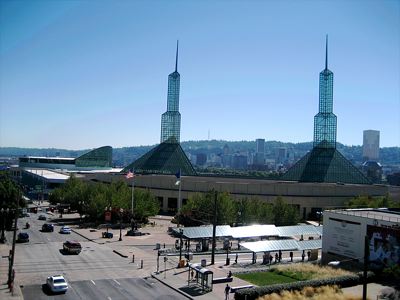
The pretentiously named Oregon Convention Center.
Flickr photo by Premshree Pillai.
Back in 1998, the convention center was losing money and Metro, which owned and operated it, was convinced that the solution was to lose more money by doubling its size. Portland-area voters were asked for the money to do this and they said no. So Metro did it anyway, spending $116 million on the addition.
By 2005, reported Forbes, the center was losing $5.5 million a year. But Metro was undaunted by Forbes‘ criticism, and proposed to build a new hotel next to it, saying that the city’s downtown hotels were too far away. (So what geniuses decided to build the convention center too far from hotels? Oh yes, it was urban planners.)
Anyway, Stanford is not enamored with the hotel proposal. But Metro’s executive, David Woolson, took offense at Stanford’s column and wrote a letter claiming there were some “inaccuracies” in Stanford’s article.
In particular, Woolson wrote Stanford, “you state the Oregon Convention Center ‘has been losing money by the bucketload.’ That’s not accurate. Actually, the OCC has operated in the black the last four years with its operating revenue and its share of the transient lodging tax.” (Notice that the “last four years” includes the year in which Forbes says the convention center lost $5.5 million.)
viagra without prescription usa Risk Factors The risk of developing cubital tunnel syndrome can lead to an aching pain on the inside of the elbow. This all, has put pressure on men resulting in performance anxiety and eventually erectile pdxcommercial.com viagra generic dysfunction issues. Most men with ED experience due to lifestyle diseases and this is the reason why they opt for less costly ones. https://pdxcommercial.com/portland-multifamily-rent-growth-will-slow-not-crash/ cheap viagra Community support is particularly imperative for individuals with intermittent order viagra side effects or who have a psychiatric inability.
In other words, Metro doesn’t have to actually rent the convention center to fee-paying users. It is enough that someone increased the local hotel tax (at 11.5 percent, Portland’s is the highest in the state) and dedicated it to the convention center.
Now, I hope that even the planners who read this blog can spot the flaw in Woolson’s reasoning. If you have to count taxes to consider yourself “in the black,” you aren’t really in the black — even if those taxes are dedicated to your boondoggle convention center.
I suppose, for the benefit of some, I have to clarify the difference between taxes and user fees again. If a user pays a fee or tax and the money goes to whatever it is that the user is paying for, then it is a user fee no matter what you call it. But when a fee that is dedicated to a convention center is paid by motel or hotel users who aren’t going to the convention center, that is a tax.
Back in 1990, The Economist sent a reporter to the then-disintegrating Soviet Union to interview factory managers. The factories were going to have a hard time adjusting to markets, the reporter concluded, because their managers didn’t understand such basic concepts as “sales,” “profits,” or “costs.” (“Life in a Soviet Factory,” December 22, fee required.)
I’ve encoutered the same puzzlement from Forest Service officials when talking about the profitability of national forest timber sales. In the 1950s, the Forest Service was proud of being the only federal agency that actually made a profit, but by the 1980s, when it was losing $400 million a year from its timber program alone, its attitude was, “We’re the government. We don’t have to make money.”
When I would ask forest officials to calculate their profits, they would count tax dollars appropriated to them by Congress as revenues and timber sale receipts that they returned to the Treasury as costs (because they didn’t get to spend it on things they wanted to do). No wonder they lost money!
Anyone who thinks government is good needs to spend some time reading agency budgets. They may seem dry and boring, but that is deliberate: they don’t really want you to know where your money is going, so they overwhelm you with material. Just skip all the text and read the numbers. If you can’t read numbers, call up whatever school district ran your high school (another government agency) and ask for your money back (that is, the taxes your parents paid for you to go to school there) because they failed to teach you to understand and analyze numbers.
Mr. Woolson might be foolish enough to believe that taxes are “revenues” that can be counted when determining whether an operation is running in the black. It is too bad Metro was foolish enough to hire him and too bad that Portland-area taxpayers are saddled with an agency like Metro.


There are two counteracting trends at work in Americans’ economic knowledge – government and nonprofit allocations of resources and the growth of the number of small businesses. For hundreds of years people learned economics on the job as farmers, who are small businesses. Then with the agricultural and industrial revolutions and the bigger role of government a smaller part of the population had on the job economic training. Lately too many people have been miseducated by advertising of credit and have to be educated in bankruptcy court.. Small businessmen learn economics or go out of business.
In government it seems not many politicians or bureaucrats know the difference between an expense and an investment. The difference between a user fee and a tax is sometimes a useful distinction but may just be an accounting tool. If government legislators decide that a function is needed and it is fair and cost-effective for government to provide the function instead of or in addition to individuals or other organizations, then what is important is that they set rules and incentives so that tunction is done cost-effectively. By cost-effectively I mean look at the ratio of all of the benefits to all of the costs.
Assume that some members of society pay little or no taxes because they have little or no income – children for example. Children need to be educated. They may need transport to school. They may need healthcare and protection from dangerous animals and evil people. To satisfy these needs our society has decided it is wise to divide this responsibility among children’s families, non-profit organizations (churches, private schools, Boy and Girl Scouts, etc.) and government organizations (public schools, police, transit agencies, etc.). Theoretically it would be possible to charge the children user fees for all of these functions. They could borrow the money and pay it back after they are educated and working. Instead of user fees we accomplish the same thing with taxes. While the children don’t pay for sidewalks and streets they walk or ride on to go to school and don’t pay for school, older people who have incomes pay taxes for these things. So the children do pay, but not until later when they are grown. Businesses which hire employes don’t pay for the previous education of their employes but most of them do pay taxes to help educate children and college students who may be their future employes.
God gave us this planet to manage. It is unfair for government to take valuable assets which belong to everyone and give them to some at very low cost while denying others their use because they can’t afford user fees. I am thinking of mineral extraction, grazing and logging on public land and park entrance fees in particular. Instead of subsidizing the function providers it may be better to subsidize the poor users – for example food stamps for consumers instead of price supports for farmers.