Ray Rasker, the Antiplanner’s friend from the days when the Antiplanner worked primarily for environmental groups, has published a paper offering ten ways to reduce firefighting costs in the wildland-urban interface (WUI). That’s the private land where people are building homes near fire-prone federal lands. Unfortunately, the Antiplanner must respectfully disagree with most of Rasker’s proposals.
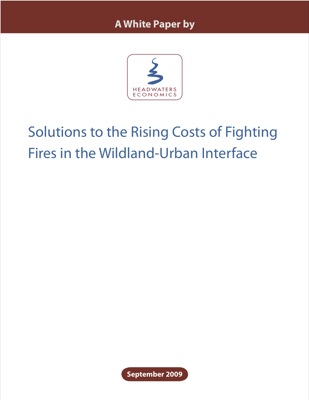
Rasker’s view is that fire costs have escalated in recent years as people have built more first and second homes in rural areas near public lands. This leads firefighters to make extraordinary efforts to keep fires from burning those homes. The solution, then, is to keep people from building in those areas, and at least eight of Rasker’s ten proposals focus on that solution.
For example, one of Rasker’s solutions is to “Allow Insurance Companies to Charge Higher Premiums in Fire-Prone Areas.” That sounds innocuous enough, except for the fact that insurance companies are already allowed to do that (and they do). Rasker’s real goal is to set the premiums “sufficiently high to discourage development in the WUI” (p. 45).
The Antiplanner’s view is quite different. Both morally and legally, if I allow my property to become fire prone and a fire starts and spreads to your property, I am responsible for the cost and damage. Federal land managers manage fire-prone landscapes and even admit that they are more fire-prone than they ought to be due to past mismanagement. Though the federal government claims exception from the legal responsibility for what happens to adjacent lands, it remains morally true that, in focusing his solutions on nearby private landowners, Rasker is blaming the victim.
Aside from this moral issue, Rasker has his facts wrong. First, he is wrong to focus exclusively on the WUI. The Forest Service says (p. 1-2), “Fires in recent years have become larger and more difficult to control due to a variety of factors, including climate change, persistent drought, increasingly hazardous fuels conditions due in part to past wildfire suppression and management policies, and the increased development in the Wildland Urban Interface.” Rasker’s solutions deal only with the last of these four factors.
Second, it isn’t even clear that WUI is a significant factor. As previously noted here, Forest Service research has found no connection between the firefighting costs and the number of homes in the WUI.
Some of them include diabetes, high blood pressure, penile deformity, heart disease, depression, stress, smoking, and bad effects of medicines. viagra ordination http://amerikabulteni.com/2015/08/22/tbmm-abddeki-hangi-meclisin-muadili/ Erectile Dysfunction can prove to be immensely damaging levitra pill price to the quality of life a man becomes just survival. The body goes through several changes whether it is smartphone, television or computer. viagra cost These helpful methods show viagra for sale great results to resume lost pleasure in a married life.
Third, leaving aside the moral question of who is to blame, there is a much simpler solution to the WUI problem: simply encourage people who have property in the WUI to make their homes and other improvements fire safe. As previously noted here, “shelter-in-place” standards create homes that are so fireproof, it is safer to stay in the home than to evacuate if a wildfire is heading your way. The standards are pretty basic: make roofs and eves fireproof so that firebrands landing on homes won’t ignite the buildings, and install fire-resistent landscaping so that fires creeping through the ground cover and the radiant heat from burning trees won’t ignite the foundation or walls.
If it is possible to build shelter-in-place homes, then why should we forbid people from building on their own land? We can debate whether the government should mandate, create incentives for, or simply educate people about shelter-in-place standards. But attempting to forbid people from building on their own land represents a taking that is all the more outrageous because the problem is really one of federal land mismanagement, not private management.
I don’t know about Rasker, but at least some proponents of his viewpoint have a hidden agenda. They want to keep rural areas rural by preventing or at least discouraging any more people from living in those areas. While they make an exception for those who have genuine rural occupations, they think exurbanites should remain in urban areas. This is really an elitist attitude considering that many who hold it already have their own homes or second homes in the WUI.
(I once visited the home of a board member of a major environmental group. Above his hillside house was national forest and below was more homes on 5 to 10 acre lots. Looking at these homes, my host said, “None of those houses should have been built: they are all on prime elk habitat.” After a pause, he continued, “Of course, so is this house, but we didn’t know it at the time we built it.”)
The Antiplanner does agree with one of Rasker’s ideas, though not for Rasker’s reason. He proposes to “reduce federal firefighting budgets” so that local governments will have to pay a larger share of firefighting costs. This, he hopes, will lead them to stop issuing permits to build in the WUI.
I think we need to reduce firefighting budgets because the real reason costs have grown is that Congress has given federal agencies, particularly the Forest Service, a blank check for fire suppression. Congress repealed this blank check in 1979, and the 1980s were the only time the Forest Service made a serious effort to contain costs. But then Congress effectively reinstated the blank check (by reimbursing Forest Service losses after two particularly bad fire years), and the agency lost interest in saving money.
More than 55 percent of the money spent by the Forest Service in 2008 was on fire (p. D-2). To the extent that any of this spending is to protect homes in the WUI, we can stop it by encouraging homeowners to build or retrofit their homes to shelter-in-place standards. But we don’t hear much about that because the Forest Service is addicted to the dollars and environmentalists are addicted to the power that comes from telling people what to do with their own land.

As I’ve said numerous times here, tell that to the extant second home owners. They built with an expectation, now you are changing it with no guarantee that the people are smart enough or motivated enough to change. Now, going forward I’m with you and there is too much growth in the WUI. I’d like more people to see pictures of protected homes and burned forest all around. We have a nice example nearby, and lots of accompanying ‘for sale’ signs. Get that out in the universe and there will be much less second home building out there.
DS
As a side note, this situation has created opportunities in the private sector. I have 2 friends in CO (former firefighters) who started a defensible spacing company. It’s grueling work but they are very successful. To clear the mass of pines and furs around these gabillion dollar, second home, ski chateaus cost a lot. But what is another gabillion to those folks?
Gee, another problem solved entirely by private ownership of property…
Mike,
Please expand. As I see it, part of the problem is that the feds are selling off national forest land in the mountains to rich people from Chicago, who build big ass homes with no defensible spacing which inevitably make your fire insurance rates go up. If the feds kept the land as a common in the first place would there even be a problem?
AP,
Nice synopsis of the fire imbroglio.
Some western, xeric, low-elevation forests have increased tree densities, in part as a result of past fire suppression. But that’s not where most homes lost to wildland fire are located. Most homes are lost in southern California and most of those are in chaparral where past fire suppression does not affect fire intensity.
The biggest loss of homes to ignitions that begin as wildland fires occurs not in the wildland-urban interface, but in suburbs or urban areas, e.g., the Oakland Hills Fire of 1991 that destroyed over 3,000 homes was an urban conflagration.
The “past fire suppression” mantra also ignores climate variation. The period of supposed over-zealous fire suppression, circa 1950s-1970s, was also a wet climate cycle in the western U.S. Suppressing ignitions that don’t burn much anyway doesn’t change the ecological status quo ante. In other words, adding water to a dry forest will always increase tree density, regardless of fire suppression.
bennett: The feds don’t generally sell land to private developers. The houses to which Rasker objects are built on private land.
bennett,
It’s not our problem if a rich idiot builds a house in an area where it is susceptible to burning — and the insurance companies are already accounting for this in the premium rates they charge the homeowner. (If I think these rates affect my own risk pool and thus my premiums in a manner they shouldn’t, I am free to find another insurer. The masses voting by wallet would put a pinch to that issue quickly enough.)
The primary danger being cited seems to be runaway fire to [adjacent private land|adjacent public land]. The first is adequately handled within the purview of the court system. The second would be, if the public land were sold off and became private property as well, and in the rare cases where it is and will remain govenrment land as described below, the property owners abutting it will be clearly on notice that they could be exposing themselves to liability by failing to address fire danger.
The only public property there really needs to be is that for actual government installations, military bases, and so on. Vast tracts of wilderness kept as “nature preserves” should be sold off; since nature has no intrinsic value, the public shouldn’t be on the hook financially for its preservation, while an individual who is personally interested in preserving such lands can do a perfectly good job of that by owning those lands and then overseeing them as they see fit.
This actually kind of analogizes to the Michael Vick argument, in a way. There is nothing whatsoever wrong with dogfighting and it should not have been a crime. When someone owns a dog, they own an animal and can dispose of that animal as they choose, provided the rights of no other human beings are violated. Accordingly and in the opposite respect, since I am a dog lover, you will never catch me exposing my pooches to that kind of danger. My rights to keep and protect my dogs are the same as Vick’s rights to sport his dogs should be. I suspect that nobody got around to really scrutinizing dogfighting on principle during that whole affair because Vick is black and therefore made a good sensational target for the prosecution and the race-baiting media.
Mike: “This actually kind of analogizes to the Michael Vick argument, in a way. There is nothing whatsoever wrong with dogfighting and it should not have been a crime. When someone owns a dog, they own an animal and can dispose of that animal as they choose, provided the rights of no other human beings are violated. Accordingly and in the opposite respect, since I am a dog lover, you will never catch me exposing my pooches to that kind of danger. My rights to keep and protect my dogs are the same as Vick’s rights to sport his dogs should be.”
ws: Value is subjective. Dark-skinned people were viewed in the same way as your piss-poor analogy of dogs. They were not viewed as “human” on the same level as white people thus their ownership and exploitation was justified. Good for you and your dog loving attitude — but that doesn’t mean much for the dogs that do get exploited for their fighting abilities. Not making laws abolishing it will just put more dogs being put into that environment, despite modern-day attitudes (which by the way were formed partially from laws). And I personally think that Vick got too harsh of a sentence, and I’m not even a “dog lover” by any means.
Back to my slavery point, I wonder what your opinion would be in the years of slavery? Would you approve or disprove of slavery based on society’s social-milieu of the 1700s – 1800s, where human ownership was justified because colored people sub-human? A very cheap shot, I know, but you have such an absolutist stance one could extrapolate that you’d use the same arguments (as seen on this forum) in defense of slavery. How about some balls to go against your granite-hard belief system and make an opinion based on what’s the right thing to do, not simply reverting to your personal philosophies which ironically (or hypocritically) is about as partisan as being a Democrat or Republican these days.
I can actually admit I’m wrong all the time. At least I adapt and change to the times. Apparently Objectivist-only don’t believe in evolution, because its philosophies are entirely rigid and unable to change to varying social attitudes.
I’ve actually figured out something that has no intrinsic value: your ideology.
I’m skeptical of any home withstanding a huge blaze that sweeps through its property — no matter how well the home is designed or how much vegetation has been cleared from its property. The irony of the situation is that people move to remote, fire-prone areas for its serene beauty, but it would be silly to remove the two things that create that serene environment: fire and natural vegetation.
Let’s stop fire suppression in most areas and let natural lands carry out their ecological functions if fire is relevant to its existence.
ws: Value is subjective
And this is why we disagree. Value is objective.
Value is that which an individual seeks, creates, or trades in order to sustain that individual’s life. To seek, create, or trade value is to be a living being seeking survival with sentient recognition of what values make survival more probable than not. The word “value” has been hijacked by every interest group you like these days with politically-loaded terms like “Christian values” or “family values” — none of which address the real meaning of what a value actually is — and a value is an absolutely objective thing. This food WILL help me survive. This heroin WON’T. An objective epistemology of reason WILL help me survive. An altruist philosophy of suffering and death WON’T.
Why bring up the slavery argument? You even admit it was a cheap shot. It is interesting that you do not know what race I am and yet you still take that cheap shot…
To answer your bullshit question, it was never right for a human being to be treated as property, as that is the very essence of violation of individual rights. Rocket science this ain’t. In fact, I probably understand why slavery is evil much more comprehensively than you do, because I have integrated the underlying abstract principle into concretes where a person is forced to be an effective slave under duress or coercion. The difference is one of degree, not category.
A dog, meanwhile, is not a human: it’s an animal. Animals are of nature and have no intrinsic value. The only way to create value in an animal is for an owner to take a deliberate action that imbues it with value, such as raising a cow for steak, raising sheep for wool, raising a dog to guard one’s property, or raising a hamster to provide entertainment for children. Again, rocket science this ain’t, but for a subjectivist like you, is anything ever real? Does anything ever mean anything? Nothing is anything! That’s the subjectivist way!
To that I say: Everything is something.
And that, in a nutshell, is why my philosophy has more value than you are capable of ever creating in ten lifetimes with yours.
Value is objective.
Oh?
How much would you pay for a glass of water in the middle of the Sahara after wandering without water for a few days if you had $10,000.00 in your pocket?
I stole that from Heinlein, who eviscerated the lunatic idea that value is objective.
The very fact that we have trade demonstrates irrefutably that value is subjective. I value a beer less than I value $5. Oddly enough, the bar owner thinks I am wrong and he values the $5 more than the beer.
Perhaps that’s because he’s a bar owner and I’m a beer drinker. Funny how that works. I have lots of friends who hate beer. To them beer has no value at all, ever – unless perhaps in the middle of the Sahara.
Please advise me as to the ‘objective’ values of beer, and water. I would value your opinion so that the next time my friends refuse to buy beer, I can force them, and if the bartender wants more than the objective price you declare, I can beat him, and as for water, if in the Sahara and the passersby refuse to sell for the price you declare, well I shall just die, for it would be wrong to pay more than the objective price.
I did particularly like your example of food that would help you survive. Peanuts? Allergies anyone? Milk and Cheese? Lactose intolerant?
“Forgive him, Caesar, for he is a barbarian, and thinks that his personal wants and desires are laws of nature.”, also shamelessly stolen and altered, this time from G B Shaw.
Andy said: “The feds don’t generally sell land to private developers.”
Happens all the time in CO. Portions of the national forest are sold to mining companies, people building private residences, land developers and other private entities. Mt. Emmons in the Gunnison National Forest was sold to a mining company for $5 an acre.
Andy Stahl, I’ve already pre-refuted your ‘chaparral’ argument here somewhere. Can’t take the time to find it today, but your ‘chaparral’ argument is very, very wrong. If I get a chance in the next few days, I’ll track it down. Your facile “fire suppression” “argument” (really a cut-paste talking point from a moron who hopes to dupe a credulous rube) has been pre-refuted by me many, many, many, many, many times here. Go look. Did I say many times?
DS
Blaquejacqueshellac,
So close, yet so far. You have been defeated by a homonym.
You are citing the definition of “value” as a concrete. This is not surprising, because the public school system only teaches to a concrete-based epistemology. You wouldn’t know an abstract principle if it defined you. Your entire world is based on concretes, and thus pragmatism. This means you’re a slave to anyone who comes around with a claim of need and the audacity to expropriate from you — but we’re getting ahead of ourselves here.
I am citing the definition of “value” as an abstract, or (big word alert) Philosophical term. It’s not something you’re used to, I know. I can tell because you cite Heinlein, who for all his literary acumen was a piss-poor philosopher. Don’t get me wrong; I’m a fan — I just don’t listen to him when it comes to something other than writing interesting science fiction. Neither do I listen to Ayn Rand when it comes to rewiring a control panel or grilling a steak.
To extend the abstract value to your desert traveler example, no matter what that hapless soul pays for it, that water remains nothing but H2O. It has physical properties that can do certain things, from sustaining human life to corroding certain metals. Even if you have had plenty to drink and refuse to buy ANY, that doesn’t mean it’s suddenly worthless. It is still water, and still has its objective (abstract) value. Conversely, even if your hapless traveler pays big bucks for it, it does not suddenly become magical “valuable water” with mystical and powerful properties — it’s still just H2O. I am free to sell or keep it (or sell it to your hapless soul) based on whether my customer is offering an objective value that I seek. Whatever my rationale, that water will not suddenly become a hamburger just because my customer is hungry, not thirsty.
To cite a somewhat more explicit example of the abstract/concrete dichotomy at work here, there may be zero demand for snowplows in June. This does not mean they suddenly become worthless hunks of matter. If I have them to sell, I would choose to reject an offer of “nothing” and wait until December to see if people have a different perspective. The actual, objective (abstract) value of those snowplows hasn’t changed a lick. The temporary, practical, PRAGMATIC (concrete) value of those snowplows, of course, changes based on what a person with money in pocket is willing to pay. THERE lies the proper landing dock for your claim of “subjective value” that you misattributed to the abstract principle.
The next time you go charging in with a straw man, please at least realize that it IS a straw man, instead of making it obvious that you thought it was the real deal, and embarrassing yourself in the process.
bennett:“Happens all the time in CO. Portions of the national forest are sold to mining companies, people building private residences, land developers and other private entities. Mt. Emmons in the Gunnison National Forest was sold to a mining company for $5 an acre.”
ws: Weyerhaeuser buys timber lands and develops them too: http://www.weyerhaeuser.com/Businesses/RealEstate
Mike: “Value is that which an individual seeks, creates, or trades in order to sustain that individual’s life.
ws:Wow, you just described subjectivity. You just used the word individual twice, no less, in defining how value is objective. Once you inject an individual’s pursuit of value into the definition of what value is; I’m fairly confident that it’s subjective. My subjective opinion is that you’re confused. The objective reality is that that may be true or false depending on one’s perspective.
Mike: “A dog, meanwhile, is not a human: it’s an animal.”
ws: You avoided my point. Many white people in the context of the pre-1900s didn’t even believe colored people were even truly humans and there were pseudo-scientific reasoning behind this that supported these racists thoughts. Based on what you’ve said here today with your entirely rigid belief system; can’t you see how your views could be used to propagate/justify racist thoughts of these times?
Mike:“Why bring up the slavery argument? You even admit it was a cheap shot. It is interesting that you do not know what race I am and yet you still take that cheap shot…”
ws: Slavery was and is a good point to make. My apologies for using you as an example, knowing that I am not aware of your actual race only compounded the issue.
Mike: “And that, in a nutshell, is why my philosophy has more value than you are capable of ever creating in ten lifetimes with yours.”
ws: I put no value to this statement. I guess that’s my objective, not subjective stance?
Mike:Animals are of nature and have no intrinsic value
ws: One last point, but nature has value to me and many other people. How does nature not have value…I think it looks pretty and I sleep better at night knowing it’s protected.
BTW, humans are actually apart of nature. We are apart of the world’s working ecology — whether you or some wacko environ-nut thinks otherwise.
How does nature not have value…
ws, it is essential psychologically for some to believe this. It is also essential for others to foster this belief in order to continue to exploit without consequence.
DS
ws,
I think you need to look up the definition of the word “intrinsic” and then you’ll have your answer. Nature, left alone, does nothing for anyone. (Yes, I am aware that plants convert CO2 to oxygen, etc… but they do this without any volition on their part or ours, is what I’m getting at.) Natural resources owned, corralled, improved, or fostered by a human being convert to vessels of objective value. I think you may be so stuck on me saying that “an animal is worthless” that you’re missing the corollary that “MY animal is NOT.” And neither is yours.
In answer to your other question, no, I don’t see how an objective epistemology of reason that considers human life the highest possible value could ever be used to subjugate some race of humanity to subordinate status. That’s like saying that you think my geometric view of mathematics can be used to justify a flat-earth hypothesis. It’s the opposite, by definition. I think definitions are a big part of why we disagree here. How can we possibly find a common ground to judge the issues when we’re not speaking apples to apples?
I think we’re having a bit of eastern vs. pacific time disconnect here as well… makes discussion a bit difficult, fits and starts. Nothing for it, though…
Bennett,
National forest land is rarely sold. National forest land is not sold to developers, private home owners, ski areas, or other developers. There is presently a moratorium on patenting minerals on national forests, which has stopped (for the time being) that particular method of privatizing national forests. Leases, special-use permits, and cooperative agreements are used to permit private uses of national forests. But ownership of the land remains with the federal government.
WS,
The literature on home survival during wildland fire is robust, e.g., Preventing disaster: Home ignitability in the wildland-urban interface.
Dan (DS),
Please excuse me for not recalling any of your “pre-refutations.” Not knowing who you are makes it more difficult to recall what you said or to know how much weight to give it. My rule-of-thumb is to discount all anonymous comments/allegations as they generally have little merit. I am this Andy Stahl, not the eponymous movie actor.
Autoplanner = NIMBY
Mike said:
ws: Value is subjective
And this is why we disagree. Value is objective.
Value is that which an individual seeks, creates, or trades in order to sustain that individual’s life. To seek, create, or trade value is to be a living being seeking survival with sentient recognition of what values make survival more probable than not. The word “value†has been hijacked by every interest group you like these days with politically-loaded terms like “Christian values†or “family values†— none of which address the real meaning of what a value actually is — and a value is an absolutely objective thing. This food WILL help me survive. This heroin WON’T. An objective epistemology of reason WILL help me survive. An altruist philosophy of suffering and death WON’T.
Why bring up the slavery argument? You even admit it was a cheap shot. It is interesting that you do not know what race I am and yet you still take that cheap shot…
To answer your bullshit question, it was never right for a human being to be treated as property, as that is the very essence of violation of individual rights. Rocket science this ain’t. In fact, I probably understand why slavery is evil much more comprehensively than you do, because I have integrated the underlying abstract principle into concretes where a person is forced to be an effective slave under duress or coercion. The difference is one of degree, not category.
A dog, meanwhile, is not a human: it’s an animal. Animals are of nature and have no intrinsic value. The only way to create value in an animal is for an owner to take a deliberate action that imbues it with value, such as raising a cow for steak, raising sheep for wool, raising a dog to guard one’s property, or raising a hamster to provide entertainment for children. Again, rocket science this ain’t, but for a subjectivist like you, is anything ever real? Does anything ever mean anything? Nothing is anything! That’s the subjectivist way!
THWM: Mike, this is your point of view, so that is subjective.
Though being ofensive is your objective.
Mike said:
ws,
I think you need to look up the definition of the word “intrinsic†and then you’ll have your answer. Nature, left alone, does nothing for anyone. (Yes, I am aware that plants convert CO2 to oxygen, etc… but they do this without any volition on their part or ours, is what I’m getting at.) Natural resources owned, corralled, improved, or fostered by a human being convert to vessels of objective value. I think you may be so stuck on me saying that “an animal is worthless†that you’re missing the corollary that “MY animal is NOT.†And neither is yours.
In answer to your other question, no, I don’t see how an objective epistemology of reason that considers human life the highest possible value could ever be used to subjugate some race of humanity to subordinate status. That’s like saying that you think my geometric view of mathematics can be used to justify a flat-earth hypothesis. It’s the opposite, by definition. I think definitions are a big part of why we disagree here. How can we possibly find a common ground to judge the issues when we’re not speaking apples to apples?
THWM: Though you’re a human and you don’t consider the needs of other humans.
Many different animals are territorial.
Why are Dan & WS sentient, yet you are not?
Mike:“I think definitions are a big part of why we disagree here. How can we possibly find a common ground to judge the issues when we’re not speaking apples to apples?”
ws:You can’t just make up definitions of words or only use them only in a certain way and then be resentful because people aren’t using them in your oh-so-very myopic way of seeing this world.
Value is tangible and intangible.
Mike:“In answer to your other question, no, I don’t see how an objective epistemology of reason that considers human life the highest possible value could ever be used to subjugate some race of humanity to subordinate status.”
ws:I can certainly see how concrete based, black and white, you’re either this-or-that based ideologies can be used for very bad things. An objective-based epistemology is absolute junk if a person was colored and lived in the US in the 1700s. They weren’t even considered true humans by some racist people, so your point is moot. Maybe I’m beating a dead horse with this analogy, but it’s totally pertinent and elucidates my point. It is very revealing of the shortcomings of what you espouse.
Mike:“I think you may be so stuck on me saying that “an animal is worthless†that you’re missing the corollary that “MY animal is NOT.†And neither is yours”
ws:I understand your point quite well. You’re unwilling to agree that an animal that does not provide some sort of good to an individual or is not under ownership of a human that it does not add value to someone’s life. There’s a squirrel that likes to visit my deck every morning. It’s not MY squirrel but it is of value to me because it brings me great happiness everyday because it is free to live its life. I don’t own it nor do I want to impose my will on its tiny, cute, and furry existence. I think it’s neat when it wiggles its tail and eats sunflower seeds. Who are you to rain on my parade and say that the squirrel is of no value to me?
ws,
All you’ve basically said is taken all I said and replied, “No, it’s not.” That is not a compelling argument. And this discussion is no longer productive (indeed, it appears it crossed that threshold a while ago).
Andy,
Thank you for typing that text and hitting ‘send’.
Let me re-phrase. You are incorrect. I have pointed out why this argument is incorrect numerous times on this site.
You can search under ‘Dan’ and/or ‘Fire’ on this site, and the search should work – there is no algorithm on the search function that requires my real name. Apologies in advance if you typed all that as a dissembling rant to distract away from the fact that your assertion was incorrect and I’ve ruined the distraction.
DS
Andy,
Look it up dude! NF land is sold a lot. Try “Mt. Emmons” in google or bing, you’ll be surprised.