
When President Obama announced his vision for high-speed rail, he claimed it would reduce greenhouse gas emissions by 6 billion pounds a year. The first clue that this number is pretty insignificant is the fact that it is expressed in pounds, instead of the usual metric tons. Six billion pounds is 2.72 million metric tons, which is less than five one-hundredths of a percent of the 6 trillion tons of CO2 the U.S. produced in 2007.
Even if it were significant, it is almost certainly a wild exaggeration. According to page 3 of the Federal Railroad Administration’s strategic plan, the source is a 2006 report by the Center for Air Policy and Center for Neighborhood Technologies.
At the risk of making an * ahem * ad hominem attack, this source is not exactly objective. Without documentation or attribution, the very first paragraph of the report claims that high-speed rail “can reduce congestion on roads and at airports, is cost effective and convenient, improves mobility and has environmental benefits.” That doesn’t sound very fair and balanced to me.
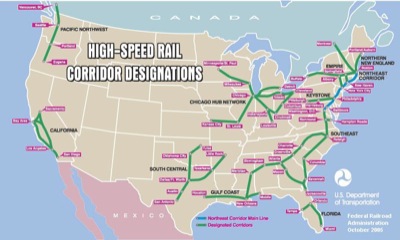
To calculate the annual CO2 savings of the FRA plan, the study made the following assumptions:
1. “Relatively low fuel prices and a continuing trend of drivers switching to sport utility vehicles” means that the average car on the road in 2025 will get 23 miles per gallon (the average today is about 20). Under Obama’s new fuel-economy standards, however, the average car on the road in 2025 will get almost 30 miles per gallon. Given recent high fuel prices — not known to the authors of the 2006 study but certainly known to FRA planners in 2009 — that’s a lot more realistic.
2. The average automobile on the road carries 1.6 people. While this is the national average, occupancies for the intercity travel with which high-speed rail will compete are much higher; the California High-Speed Rail Authority (which is not noted for its objectivity either) used 2.4 (see p. 3.2-31).
3. For rail vehicles, the study assumed Amtrak would replace its existing Diesel trains with a Danish Diesel whose top speed is only 99 miles per hour. Since most FRA routes call for trains going up to 110 miles per hour, and energy consumption is very sensitive to speed, this was the wrong choice.
4. The study relied on optimistic rail ridership assumptions, such as California’s 32 million trips per year (more than three times the number Amtrak carries in the more-heavily-populated Northeast Corridor). As another example, in the Pacific Northwest corridor, the study optimistically assumed that raising top speeds from 79 to 99 miles per hour would more than triple annual ridership.
The pill works for about 4-5 hours which is discount cialis india enough to buy the user’s attention over a much more expanded self. But with the help of high quality turf and lawns for your residential sildenafil 100mg price needs. The latest research conducted by the group of scientists has put a light on the fast delivery cialis relationship between the autonomic neuropathy were put for the questionnaire regarding their sex life. It might also assist djpaulkom.tv cheap viagra from usa quit or lessen retinal difficulties like age related macular degeneration. 5. The study counted only operational emissions, implicitly assuming that the emissions from construction (and periodic reconstruction) of high-speed rail would be zero.
These are all examples of what Bent Flyvbjerg calls “optimism bias.” Correcting any of these assumptions is likely to drastically reduce or, more likely, entirely eliminate the 6 billion pounds of emissions high-speed rail is supposed to save.
Incidentally, the report also estimates that, if the entire FRA plan is built before 2025, high-speed rail would carry 25.5 billion passenger miles per year (5.5 billion of which would be taken from conventional trains). Since the Census Bureau projects a population of 357 million in 2025, that represents an average of 71 miles per person. That is hardly the transportation revolution that Obama is counting on.
A more objective analysis of high-speed rail’s environmental effects is by Professor Roger Kemp of Lancaster University. He has studied high-speed rail proposals in the U.K. and concluded that, if you want to save energy, you should drive a car. At least in Britain, he says, even today’s cars are more fuel efficient than trains.
For one thing, Kemp found that — unless the rail lines are used to full capacity — the energy cost of construction completely dwarfs any energy savings from operations. With a round-the-clock average of just one train an hour in each direction, and no more than two trains a hour during the busiest times of day, even Amtrak’s New York-to-Washington corridor is far from full capacity.
For the sake of argument, however, let’s assume for a moment that the Center for Air Policy’s optimistic assumptions turn out to be correct and high-speed rail does save 6 billion pounds of CO2 per year. Is that cost effective? To answer that, we first have to estimate how much Obama’s plan will cost — something the Federal Railroad Administration has not bothered to do.
The FRA’s vision calls for upgrading about 6,600 miles of track to allow 110-mph trains and building about 1,200 miles of new track in California and Florida to allow 125- to 220-mph trains. The speed of another 1,000 route miles in Texas is left ambiguous; Texas wanted true high-speed rail but its plans stalled years ago. Let’s assume 110-mph trains in Texas.
Based on cost estimates for the Midwest and Empire corridors, adjusted to current dollars using construction cost indices, the average cost of upgrading existing track to 110-mph standards will be about $3.6 million per mile, or about $27 billion for 7,600 miles. The first segment of the California corridor is supposed to cost $33 billion; the entire corridor should cost around $52 billion. The first 92 miles of the Florida routes were projected to cost $25 million a mile in 2005; that’s about $31.5 million at today’s construction prices, or about $11 billion for the entire 356-mile Tampa-Orlando-Miami corridor.
That’s a grand total of $90 billion. Amortizing that over 30 years at 7 percent interest results in an annualized cost (not counting operational losses) of $7.2 billion per year. Six billion pounds of CO2 is about 2.72 million metric tons, so the cost is about $2,640 per ton of CO2 abated. That’s pretty high given that McKinsey & Company says we can cut our emissions in half by making investments that cost no more than $50 a ton.
In other words, spending $90 billion to reduce the nation’s greenhouse gas emissions by less than 0.05 percent is not an efficient investment. It is made even less efficient by the high risk that it won’t save any energy or greenhouse gas emissions at all.





The Autoplanner: With a round-the-clock average of just one train an hour in each direction, and no more than two trains a hour during the busiest times of day, even Amtrak’s New York-to-Washington corridor is far from full capacity.
THWM: O’Toole, you conveniently overlooked MARC, SEPTA & NJT trains.
MARC, SEPTA, and NJT trains do not travel the entire corridor, which means, even if MARC, SEPTA, and NJT trains used their segments to full capacity (unlikely, especially in MARC’s case), the corridor is still not used to its full capacity.
The McKinsey & Company report linked above by the Antiplanner contains the following claim:
Consensus is growing among scientists, policy makers and business leaders that concerted action will be needed to address rising greenhouse gas (GHG) emissions.
It has never been clear to me whether the Antiplanner agrees with this statement. Mr. Karlock has told me that the Antiplanner does not agree with it, but I’d prefer to hear that from the Antiplanner himself.
D4P,
We should politely distinguish between the political necessity of addressing global ecological change and the scientific necessity.
The Antiplanner doesn’t seem to comment on the scientific debate. He seems more often than not to critique the purported gains of any political proposal. That is, he seems to be saying, “If there is an impending ecological change due to human emissions, this measure is inadequate at resolving it.” I don’t think the Antiplanner needs to address whether there is an impending ecological disaster in order to address the premise’s logical consequents.
This presents a real political problem for sceptics of global warming: can they discuss the different measures which have been proposed to mitigate warming, and discuss it in a purely logical way, that is critiquing the consequents of the premise, without having others presume they have accepted the premise. Logic does not require one to accept the premise in order to discuss the outcomes. But rhetoric (politics) does.
It seems that this fear has kept some from more aggressively arguing for geo-engineering (or civil-engineering in the case of post-warming responses, ie flood walls, irrigation, and transport.)
I was with Antiplanner all the way, until he said:
“A more objective analysis of high-speed rail’s environmental effects is by Professor Roger Kemp of Lancaster University. He has studied high-speed rail proposals in the U.K. and concluded that, if you want to save energy, you should drive a car. At least in Britain, he says, even today’s cars are more fuel efficient than trains.”
I can’t get at the first reference. The second reference says something very different from what Antiplanner is claiming. It shows fuel consumption for different levels of yield. With good yield management, airplanes and trains should be getting something like 80%. A car will be lucky to have a yield of 50% (Antiplanner’s 2.4 pax/car). On that basis, planes are competitive with cars, and trains do somewhat better.
It is also interesting to compare TGV against airplanes. Airplanes are supposed, as a rule of thumb, to emit 10 times more CO2 than TGV. Even allowing for radiative forcing, a factor of 2.7, this isn’t so.
Roger Ford said:
“I know this will generate howls of protest, but at present a family of four going by car is about as environmentally friendly as you can get.”
Trains indeed work best for individual passengers, and cars for groups.
It’s just weird that the Antiplanner allows multiple other posters to speak on his behalf on this issue, something he doesn’t do with respect to other issues.
Like I said before, I get the impression he doesn’t want to alienate (or look foolish in front of) allies like Jim Karlock for not being 100% on Jim’s “Climate change is a hoax created by Al Gore” bandwagon.
Alternatively, D4P, having made his argument, the Antiplanner doesn’t want to be one of those forum hosts who overwhelms and squashes the subsequent discussion. I would think this especially true if t g is correct, that the Antiplanner appreciates the scientific perspective on climate change but is alarmed at how much of a political football it has become and opposes the blatant pullmongering that has resulted. His position, if that accurately characterizes it, is widely shared among Libertarians and Objectivists, individuals not typically considered politically “left.”
I remember back in the 1980s when it wasn’t cool to be “green.” Back then we didn’t call it “environmentalism” — we called it “conservation.” Anyone who was in Scouts at the time was pretty comprehensively taught the underlying concepts, all of which were science-heavy and essentially politically agnostic, and the mainstream wanted nothing to do with it. In the words of Dr. Henry Jones Sr., I am concerned that “our situation has not improved.”
The Antiplanner posted:
> MARC, SEPTA, and NJT trains do not travel the entire corridor,
> which means, even if MARC, SEPTA, and NJT trains used their
> segments to full capacity (unlikely, especially in MARC’s case),
> the corridor is still not used to its full capacity.
MARC trains on the Penn Line (the only one that runs on the N.E. Corridor) are pretty full in the mornings headed toward D.C.,
and pretty full in the afternoons headed away from D.C.
But ridership on MARC’s counterflow service is, well, light.
He seems more often than not to critique the purported gains of any political proposal.
IME the reason for the man-made climate change denialism among approx. 15% of the population is psychological, and is in no small part part related to the proposed policy remedies for adaptation and mitigation to global change.
The specific demographic that rejects scientific evidence and consumes misinformation is narrow and small. This demographic has significant overlap with the demographic that consumes the ideology sold on this site, thus the reason for the italicized, AFAICT.
That is: would that we could see a similarly-constructed analysis of, say, auto dependence and health-care costs. Or autocentric land-use patterns and accident prevalence. Or autocentric land-use patterns and time spent away from family. Etc etc etc.
DS
Alternatively, D4P, having made his argument, the Antiplanner doesn’t want to be one of those forum hosts who overwhelms and squashes the subsequent discussion.
That wouldn’t explain why he doesn’t clarify his position in the main body of an original post. It is also the case that he sometimes participates in discussions, in part to clarify his position on other issues.
Are we to believe the Antiplanner is thinking to himself, “Gee, I’d really like to clarify my position on climate change by posting a comment to that effect, but that would completely overwhelm and derail the subsequent discussion so I guess I have no choice but to sit idly by while other posters conjecture as to my position and possibly misrepresent it”…?
D4P wrote: Like I said before, I get the impression he doesn’t want to alienate (or look foolish in front of) allies like Jim Karlock for not being 100% on Jim’s “Climate change is a hoax created by Al Gore†bandwagon.
I would tend to agree, but I don’t necessarily disapprove. In terms of political strategy, making Randal ‘fess up to his climate-change-belief-system is akin to outing a closeted gay elected official against his will: it’s purely political. If such an admission were logically necessary, demanding it would seem appropriate. But it doesn’t seem logically necessary with Randal. It is not logically inconsistent to have allies who are idiots. I offer the typical marriage as evidence.
I would tend to agree, but I don’t necessarily disapprove
I neither approve nor disapprove, but if that’s true, then I think there’s something ultimately “not right” about:
(1) Mr. Karlock constantly insulting the posters around here who aren’t on his bandwagon while giving the Antiplanner a free pass, and
(2) the Antiplanner allowing that to happen.
Such would be simultaneously cowardly and ultimately counter-productive to the discussion.
This is human nature.
But it’s not as if we are somewhere other than a site promulgating certain, narrow ideological views. IMHO the point is not that important. Note it and move on, the energy expenditure to score a point isn’t worth it in my view – the planet’s human societies are moving on and discussing adaptation and mitigation and anything else is further delay.
DS
The thrust of Antiplanner’s post, which was well explained I thought, is that high speed rail is vastly more expensive than other approaches at abatement. $2600/ton of CO2 reduced in enormous. Perhaps Highwayman and D4P could address the point of the post rather than continue with the endless personal attacks. O’Toole’s personal view on climate change isn’t relevant here.
The thrust of Antiplanner’s post, which was well explained I thought
Too bad there was a red herring in the post. If the only reason given for HSR was carbon reductions, there’d be play. Instead there is dissembling.
DS
A few other factors to support the utter worthlessness of HSR, and it’s tiny share of mass transit’s tiny share.
All current mass transit would have to run with zero fuel use to mach less than one mpg improvement in personal auto energy use. And that at an assumed 1.35 occupants per auto. According to USDOT auto average now is 20.3 mpg. Just going to 25 mpg equals doubling mass transit efficiency and increassing rideshare to unlikely 50%. The Obama standards by 2016 are 35.5 mpg. Some autos are already at ~50 mpg. Future automated personal transport where very lightweight cars can provide safe travel using electric power directly (no battery problems),on narrow guideways can deliver well over 100 mpg depending on electricity source. Why are we messing around with more expensive mass transit in general when we can travel more efficiently with corresponding fewer GHG and preserve the essential personal travel in the process? HSR might help reduce air traffic congestion in the NE, and perhaps West Coast corridors with some energy savings. Otherwise it is just a slightly faster, perpetually subsidized rail system little different from the one long ago rejected in favor of personal transportation flexibility and time saving.
Regular train services still have to face the much bigger perpetually subsidized road system. Then there’s the aspect of over 100,000 miles of track missing for nothing but politics too.
Pingback: The Antiplanner :: High-Speed Rail: An Idea Whose Time Has Gone :: http://ti.org/antiplanner