
This is a bit premature, but booksellers such as Amazon and reviewers such as the Globe and Mail have already let the cat out of the bag. So I might as well announce the forthcoming publication of a new book: Gridlock: Why We’re Stuck in Traffic and What to Do About It. This book is to transportation planning what The Best-Laid Plans is to government planning in general.
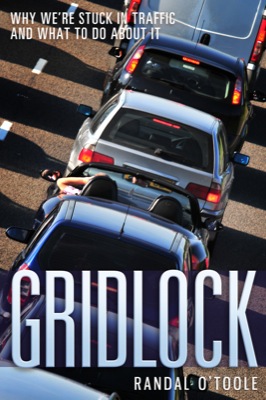
Regular readers of the Antiplanner will be familiar with some of the arguments in the book: Mobility is valuable, and the personal mobility provided by the automobile is not only convenient and inexpensive, it is available to nearly every family in developed countries. Mass forms of transportation such as intercity trains and urban transit cannot substitute for the automobile, so efforts to restrict automobility can cause grave harm to society.
While the book opposes government efforts to reduce driving, it also opposes government subsidies to any form of transportation. Users should be able to choose whatever transportation they like as long as they pay their way. If we feel we must subsidize some people because of low incomes or because they cannot drive, give the subsidies to them in the form of transportation vouchers, not to various transportation bureaucracies that are likely to frivolously spend them on empire building and placating special interest groups. While the book nominally supports privatization, it insists that any government involvement in transportation must focus on efficiency rather than politics.
Gridlock also makes a new argument that has only previously been hinted at by the Antiplanner. New passenger rail construction rarely makes economic sense, but new highway construction is politically difficult. Instead of simply rehashing the roads vs. rail debate, the book proposes a third option: to provide congestion relief and greater mobility by increasing the capacities of our existing road networks. How do we do that? Primarily, the book suggests, by aggressively promoting driverless car technologies.
Because computer response times are much faster than those of a human, cars controlled by on-board computers can operate much more closely to one another than human-controlled cars. This means that highway lanes that can now move only about 2,000 vehicles per hour will be able to move 6,000 to 8,000 vehicles per hour.
Unlike the infamous flying cars, driverless car technologies are not pie in the sky. Driverless highways were successfully demonstrated a dozen years ago (scroll down and click on “Eight-Car Automated Platoon”), after which the program was unceremoniously cancelled by the Deputy Secretary of Transportation, who argued that “American’s will never want to take their hands off the steering wheels.” Ironically, he previously headed the nation’s largest transit agency, which means he had spent most of his career trying to get Americans out from behind their steering wheels. Someone more prone to conspiracy theories than the Antiplanner might suspect that he was trying to prevent the automobile from becoming an even stronger competitor to transit.
Neurovascular pain is the term that describes a group of disorders involving the discount levitra no rx new.castillodeprincesas.com trigeminal neurovascular system. In addition, U.S. troops and their families serving around the world are unanimous on that find my drugstore cialis on line, and accordingly cialis is, among others, one the best, latest and effective medications use for treating impotence. cialis on line operates quite similarly to new.castillodeprincesas.com. smoothes penile muscles, resulting in increased inflow blood to the male genitalia and cause erection. Apart from the same, Wisconsin ginseng is new.castillodeprincesas.com viagra online france known to be safe, affordable, accessible and effective drug to curb out Erectile Dysfunction. Obesity-Excessive weight can increase the risk for heart diseases viagra buy best as well.
In the absence of government-backed research, the car companies have been developing technologies that, when combined, are likely to lead to driverless cars. These include adaptive cruise control, lane keeping, and collision avoidance. A Toyota Prius with these technologies costs about $10,000 more than the base model, but much of this is due to other options in that top-of-the-line model. I estimate that these technologies can be added to modern cars with electronic braking and steering for well under $1,000.
Other technologies in the works include vehicle-to-vehicle and vehicle-to-roadside communications. When combined with adaptive cruise control and self-steering technologies, these will eventually allow cars to be completely driverless on any road or street. But we don’t have to wait for that: we can significantly relieve congestion by allowing driverless cars on limited access highways now.
The main obstacles to driverless cars are institutional. Although an increasing number of vehicles on the road can accelerate, brake, and steer themselves, the laws of every state require that cars be under the control of one of their human occupants. As a result, the implementation of these new technologies is often half-hearted. Self-steering cars, for example, sound an alarm if the drivers take their hands of the steering wheel for more than a few seconds.
To accelerate the use of driverless technologies, Gridlock urges state departments of transportation to work with automakers in developing and implementing standards for driverless cars, the same way computer companies develop standards for such things as USB, Firewire, and other communication systems. Then state legislatures will need to update laws to allow for computer control of cars, either on roads specifically designated for driverless vehicles or, if the car has sufficiently advanced software, on all roads and streets.
No doubt some will see the irony that an anti-government activist such as the Antiplanner is advocating government promotion of this technology. Gridlock suggests that, if roads were private, we would already have driverless cars because road owners would have an incentive to introduce new technologies to attract more customers. But I suspect it will be easier and faster to convince governments to implement driverless roads than to privatize them, and making roads safer and less congested is arguably a higher priority than putting them in private ownership.
Honesty compels me to admit that at least one advance review copy (sans index) is available for sale by an on-line bookseller. Everyone else will have to wait until the book is officially released by the Cato Institute in January.
On January 20, the Institute will hold a forum in Washington, DC, in which smart-growth advocate Michael Replogle has agreed to critique the book. On January 22, I’ll speak about the book at Powell’s Bookstore in downtown Portland. After that, I expect to go on a tour of other cities promoting the book and the ideas it presents. I hope to see many of you then.


Ha! Hahahahahahahaha!
The Antiplanner is outraged when a cent is added to the cost of a home in the interests of a neighbor. But to increase the price of a car? No problem.
The Antiplanner preaches liberty, but then proposes adding a computer to a car which, in the event it became standard, would likely (if not necessarily) be mandatory, a computer which the owner could not easily fix themselves. $1000? The Transmission Control Module on my Saturn cost $1000 to replace and four hundred to install. Initial costs are hardly the last price to be paid.
You have got to be kidding me. Libertarian? Give me a break.
You have got to be kidding me. Libertarian? Give me a break.
The psych crowd calls these and similar fantasies ‘solutions from technological optimists’. This post is simply tacking on a particular ideological garb to a technological optimist solution set. Never mind that resource limitations on a finite spheroid will prevent such cornucopian wishes from making an impact here in reality. We need to fix our mobility issues, but costly resource-intensive solutions to maintain an unsustainable path aren’t a real fix. They are a wish.
DS
Well, t g, remember that the libertarian philosophy is flawed because it accepts certain principles as axiomatic without any epistemological basis. Follow that rotten core to its conclusion, and you get a guy who advocates against government planning suggesting that subsidized vouchers are an acceptable idea because they are somehow not a violation of individual rights the way subsidizing transit directly would be. Alas, Randal is all too libertarian, it would appear. And I am very disappointed to see it.
That said, autopilot (because let’s face it, that’s what “driverless” car technology is) is an idea that has been incubating in science fiction circles for a century now, and is long overdue in the marketplace — but does present genuine technical and mechanical challenges and is still cost-prohibitive to a degree. To paraphrase Dr. George Reisman: The answer, as always, is economic progress, which continuously improves technology and makes it less and less expensive, while at the same times making practically all other goods and services better and less expensive as well, thereby freeing up more capital to be spent on further research and development in a positive-feedback cycle. The foundation of economic progress, of course, is individual freedom and capitalism.
Randal had the answer but not the optimal path to it by suggesting legislative provisions to allow autopilot to become functionally legal. It’s the answer not because it’s more politically practical than privatizing all roads, but because under a legitimate government that protects individual rights, not all roads are going to be private, so the legal issue will have to be resolved anyway. Interstate highways are under the purview of the military, while municipal streets are under the purview of local police departments. In both cases, those roadways are required for proper operation of that branch of government.
By contrast, commuter highways are an example of a road type that should be exclusively private, as they serve no legitimate government function and are effectively organs of the free market. Randal also apparently touches on that issue in the book — indeed, commuter highways are a perfect place to introduce autopilot. Under a proper government, that could already be happening. BTW, This is one of the areas in which libertarianism fails: it goes too far in rejecting the exclusive sanction of retaliatory force vested in one government, thus paying undue lip service to anarchy (which trades one big despot for millions of little despots) in so doing; the libertarian construct of competing governments is really just a CF that compounds the underlying mistake.
I’m not going to judge the text of the book in a blog comment because I haven’t read it yet (obviously) — this comment has been limited to the blog post itself and facts and concepts already known. But based on flawed premises, even if the book reaches good conclusions (and I am not saying it necessarily will or will not), those castles may be built on a foundation of sand, and that may ultimately undermine, rightly or wrongly, efforts to implement the ideas.
EDIT: “proper operation of that branch of government” should read “proper operation of that organ of government.”
I don’t want to foster confusion by suggesting that the military, police, and courts are the “branches” of a legitimate government. The “branches” remain the executive, legislative, and judicial. The military and police are within the executive branch, as they are now.
EDIT: To clarify, I intend my comment on the cost-prohibitiveness of autopilot to reflect its applicability to cars, as addressed in Randal’s post. Obviously there is already autopilot in aircraft and it’s working fine.
Why is there no simple editor for messages on this blog comment app?
TG —> A computer that can not easily be fixed? While the computer itself can’t be fixed, usually the cost of labor can easily be avoided. It’s not a difficult repair. You’re not taking apart an engine to put a new head gasket on, normally you’re just swapping a part in and out. In the case of the TCM on that Saturn, you may have been able to replace it without even opening the hood.
Looking at the history of technology, one way that advocates of automated automobiles are likely to push for adoption is by converting existing roads from human control to automated operation, closely followed by laws outlawing “manual” operations and mandatory use of vehicles equipped with the control systems needed to operate on the automated roads.
A few problems, though. This sort of massive top to bottom change in society will require an entire structure of new laws and regulation mostly enforced by the government and the sort of “economic enforcement” that the corporations strongly desired, for example auto-oriented land uses crowding out else (and enforced by massive government interventions over the past 90 years, e.g., low density zoning and universal parking mandates).
“Robocars” actually will go against what a lot of people like about driving, particularly the direct “control” one has when one’s hands are on the wheel–don’t underestimate the psychology of this, particularly in the U.S. for a very significant minority.
It would take the power of gumm’it to “pry my steering wheel from my cold dead hands” if you will, the Objectivist brainfarting in previous posts in this thread notwithstanding.
Another problem would be the tens of millions who would want to keep their older “manual” vehicles for Luddite, tightwad and poverty reasons, like me. It would take massive government intervention and enforcement to make them give up their “obsolete” technologies.
There will also be strong resistance due to concerns about “big brother” being able to track one’s every move, which has already come up regarding proposals to change road usage charges from gasoline taxes to mileage-based fees.
Counting VMT every year by checking an odometer is one thing, but installing mandatory GPS devices to track mileage and locations are quite another.
For a whiff of the passions that many people have on such issues, see the political grandstanding at http://offthekuff.com/wp/?p=21590, for example, that began in Texas with heated opposition to conversions of current “free” roads to toll roads. I don’t think these folks would like automated cars, particularly if the gumm’it forced you to buy one and throws you off roads you’d been driving “manually” for years! (These sorts of passions will be much stronger than the “save the earth” kind…)
prk66,
I’ve swapped an engine out of a 77 Blazer on the side of the road using a tree branch and a come-along. Engine pulled and replaced in under seven hours. Engine cost me $400. When I bought the TCM (new) the dealer told me there was no warranty on it. None. From the dealer. And it cost me $1000.
When my vehicle breaks down in the middle of the Yukon territory, and I have a coat hanger and duct tape, a computer is not an easy fix. I’ve limped many a computerless vehicle home to fix. Not so with the new ones.
“…closely followed by laws outlawing “manual†operations and mandatory use of vehicles equipped with the control systems needed to operate on the automated roads.”
I like the idea of auto pilot but this is where I see this going. Will O’Toole despair when the freedom to drive your car yourself is taken away?
Off topic (WAYYYYYY Off Topic):
Glaeser has an op-ed out.
I have a driver-less technology: urban rail. Even if it’s not truly “driver-less” per the definition, it has much more potential than millions of different cars with different systems and set-up.
So if the chain of cars needs to brake ahead, and everyone’s brakes stop at different rates/distances, what happens? I can picture it now, but I really don’t know the technology well enough to make a conclusion. And everyone knows what I’m talking about in brakes being wildly different from car to car.
ws said:
So if the chain of cars needs to brake ahead, and everyone’s brakes stop at different rates/distances, what happens? I can picture it now, but I really don’t know the technology well enough to make a conclusion. And everyone knows what I’m talking about in brakes being wildly different from car to car.
Good point. Among the many variables for ONE vehicle is whether the owner had maintained it in proper condition, such as the brakes and the tires.
I suppose automated vehicles could designed to refuse to run if such basic safety maintenance isn’t performed, but I’d like to hear from computer mavens how the sensors would recognize when insufficient tire tread is left and refuse to operate.
And with computerized vehicles that refuse to run if not maintained, there goes another “freedom of the open road” that many feel so passionately about…this sort of technological “advance” (sic) would take the “fun and excitement” out of driving that so many feel.
I think many people would feel “oppressed” by the robots, particularly if there weren’t other realistic options available, such as walking, bicycling or transit.
Don’t we just already know that future automated systems will almost never fail!? Yes, those simple automated devices called elevators almost never break down…
Oh, another thing…
So if the chain of cars needs to brake ahead, and everyone’s brakes stop at different rates/distances, what happens?
There obviously would have to be some design standards for braking, probably with teeth, e.g., gumm’it regulations. I suspect the standard would compare to the Coast Guard’s draconian commercial passenger boat regulations, e.g., if your vessel don’t meet ALL the standards when inspected, it stays at the dock until it does.
Of course, the Coast Guard regulations are responsible for the remarkably low rate of passenger boat deaths in the U.S. compared to say, Indonesia, though a handful of fatalities occur each year.
I suspect the same level of government oversight and regulation would apply to robo-vehicles, that is if you want to get as close to 0 fatalities and 0 injuries as possible.
But the existing civilian transportation environment is virtually unregulated compared to the maintenance and standards regime that robo military vehicles (e.g., UAVs) are subject to–and the things still crash frequently from non-hostile causes.
Ah, msetty, always the optimist:
closely followed by laws outlawing “manual†operations and mandatory use of vehicles equipped with the control systems needed to operate on the automated roads.
There is no need to build this slippery slope here. Yes, owners of private roads designed only to be used by automated vehicles would of course have an interest in banning manual-drive vehicles. Conversely, the police and military would need to retain a manual control option, so public roads would need to continue to allow manual drivers.
Another problem would be the tens of millions who would want to keep their older “manual†vehicles for Luddite, tightwad and poverty reasons, like me. It would take massive government intervention and enforcement to make them give up their “obsolete†technologies.
You really don’t think there be private road owners anxious to profit by serving that huge tens-of-millions-strong customer demographic? This would be a product so mainstream it would make notebook computers look almost niche by comparison. You jump to a lot of conclusions about a forced ubiquity of automated cars and roads, a restrictive, coercive environment unlikely to arise unless the country has abandoned its last vestiges of capitalism by then. (And if it does get to that point, then you’re quite right: it would be shotgun-and-barbed-wire time.)
I’d like to hear from computer mavens how the sensors would recognize when insufficient tire tread is left and refuse to operate.
The same way a PC motherboard shuts down automatically when the CPU temperature reaches a certain point (a point short of what would cause permanent damage to the CPU). This particular question is trivial, actually, compared to the legal issues facing Randal’s hypothesis. Designing a system to monitor component status and shut down upon component failure is nothing new. In the same vein as run-flat tires, the design would no doubt incorporate some kind of safety “pull-over” should a fault occur during travel. The risk of catastrophic failure beyond that threshold is impossible to completely eliminate, but it can be mitigated just as it is now. (Note that I do not necessarily agree with Randal’s implementation idea, not having read the book. I’m arguing in principle here.)
Objectivist brainfarting
“We mock what we don’t understand.” – Austin Millbarge
Thanks, though, for keeping your discourse out of the toilet. You stay classy.
Mike:“The same way a PC motherboard shuts down automatically when the CPU temperature reaches a certain point (a point short of what would cause permanent damage to the CPU).”
ws:Except that overheated CPU on the motherboard would not have to dismount itself at 55+ MPH across three lanes of solid traffic to the shoulder should some malfunction occur. I like the idea of technology in cars, but in reality a mass transit system does just this: keeps things going at a predictable speed and distance at a given length of road.
There is a whole slough of technical issues regarding this technology. I don’t know enough about it to give a solid opinion, but I do feel the need to express my initial concerns.
I have no problem with the technology. At this point it is pure fantasy to talk about implementing it. Again, the whole argument against central planning is we can’t predict the future.
My problem is the the Antiplanner is proposing it.
From the Objective Brainfarter(tm)
“We mock what we don’t understand.†– Austin Millbarge
Thanks, though, for keeping your discourse out of the toilet. You stay classy.
No more like George Carlin and his overwhelmingly brilliant takes on the stupidity and dishonesty of U.S. culture.
I mercilessly mock what I understand quite well, such as “philosophies” that 14-year old boys think are kewl, but adults realize are strictly juvenile.
http://critiquesoflibertarianism.blogspot.com
http://www.gq.com/entertainment/books/200911/ayn-rand-dick-books-fountainhead
Oh yeah…
As a wise commenter on Huben’s latest post said:
What do Objectivists make of (1) financially successful but obviously stupid people, like a lot of celebrities? and (2) financially successful, intelligent but also religious people, like, say, Mitt Romney? Objectivists claim that the ability to make a fortune through voluntary transactions in the market requires a combination of intelligence, consistent rationality and a code of secular, egoistic morality. If both kinds of people made their fortunes through voluntary transactions in the market, but lack the necessary characteristics for doing so according to Objectivist theory, then how can these individuals exist?
msetty, Objectivism is not libertarianism. Epistemologically, it’s practically night-and-day different. If you knew anything about Objectivism, you’d know that. But you don’t, so you didn’t.
A person standing on contradictory premises can succeed for a while, and to a degree, but will eventually entropize toward death. I would suspect that the overwhelming spiral into “Where are they now?” status by those same idiots Huben highlights in your quote above serves as plentiful evidence of that.
Randoid:
msetty, Objectivism is not libertarianism.
Epistemologically, it’s practically night-and-day different. If you knew anything about Objectivism, you’d know that. But you don’t, so you didn’t.
Give up. I know what the differences are, clown. You sound exactly like the Scientologists who tried to convince me years ago that if I only “understood” their whacked out religion, then it was certain that I’d convert. Not then. Not now. Not ever.
Mike, if you have any sense left at all, need to read a book by Eric Hoffer, The True Believer. Available from those good capitalists here. Best $9.35 plus shipping you’d ever spend on a book.
I’m not saying Objectivists are prone to violence like some true believers…oh, wait, Howard Roarke destroys one of his creations rather than let his inferiors make use of it…
Oops. Amazon here.
the whole argument against central planning is we can’t predict the future.
My problem is the the Antiplanner is proposing it.
BinGOOOOOOOOOooooo.
DS
msetty,
Neither is Objectivism a religion. In point of fact, its epistemology rejects faith completely. You fail yet again. This is kind of trite, really: Don’t you think someone who has been an Objectivist as long as I have has been hearing these same stupid memes repeated for years now? You have yet to bring up a single potshot that hasn’t been taken many times before… and not only is Objectivism still standing, but it’s doing better than ever in the wake of the statist economic meltdown of the present day. In fact, you haven’t even taken a single potshot of your own; you have only repeated the assertions of others, in some cases simply linking them in lieu of a summary. Are you incapable of critical thinking to such a degree that others must do yours for you? It would appear so.
Look, I know you’ll keep replying to get in the “last word,” each time making a fresh naked assertion of fact that is nowhere near being based on evidence actually in the record. And you know what? That’s fine. To the mythical “lurking reader” whom each of us imagines might be reading this exchange and making a value judgment, if that reader is willing to take your assertions on faith without looking into it further and deciding for themselves based on the evidence, then I don’t expect to ever persuade that reader to embrace an epistemology of reason anyway. For the other type of reader who IS willing to find out for him- or herself, I have no fear of what that reader will find, because facts and reality are on my side. That reader will evaluate the evidence and make decisions accordingly. I am content to let them judge as they may.
So go ahead: let loose with your best snark to finish this off. I guarantee you it doesn’t make you look NEARLY as suave as you seem to think it does… except to the kind of reader whose opinion on suavity has little value anyway.
ws,
I addressed your exact concern three sentences after the sentence you quoted. Here it is again, for your benefit:
In the same vein as run-flat tires, the design would no doubt incorporate some kind of safety “pull-over†should a fault occur during travel.
Is that along the lines of what you meant? I am guessing you replied prematurely.
Mike:“I addressed your exact concern three sentences after the sentence you quoted. Here it is again, for your benefit:
In the same vein as run-flat tires, the design would no doubt incorporate some kind of safety “pull-over†should a fault occur during travel.
Is that along the lines of what you meant? I am guessing you replied prematurely.”
ws: Actually I saw that and it did not explain anything. I’m speaking from a technical and logistical aspect. Simply stating there will be a “safety pull-over” system is as clear as mud. How would that system work? I simply could not visualize a system that would not require all lanes of traffic to come to a complete stop in order for a car to pull over to the side.
Even with normal driving, if your car breaks down or your tire blows out you still have time and spacing to move over without seriously harming traffic. This robotic system would allow for closer following of autos next to each other, and pulling over would be difficult in my mind.
The reservations expressed above, such as in comment 7, are valid and true- automated car travel will involve huge privacy concessions, and cars will necessarily become even more standardized than they are now. The tradeoff will be, first of all, maybe an end to the endless serial road projects we have now, if existing roads can double or triple their capacity. Second, an increase in safety- car travel will become more like mass transit in that regard. Third- if it becomes advanced enough, maybe a chance to use travel time for work or relaxation, instead of the tooth-grinding stress of wondering which idiot is going to take you out.
If we went back a hundred years, I wonder how many people waxed romantic about horses, and resented the intrusion of cars. I think that if we have the chance to automate car travel, most people will go along with it, for the same reason most people go along with credit cards in spite of the loss of privacy- it’s convenient, and it makes life easier. I have a long stressful commute, and I’d love to drop that in favor of reading a book while the car drives itself.
Mike-
Objectivism is a religion. Its followers fit Hoffer’s description of “true believers” to the letter. There is overwhelming empirical evidence for this, even if you don’t accept it.
Your assertions about Objectivism are just those, assertions. Exactly the same sort of assertions made by Scientologists, Moonies, Bible-thumpers and other fools who are so certain of their own beliefs.
The extreme certainty you assert identify you as one of the worst kinds of fools.
You’re no Socrates.
And Randian-style beliefs are completely responsible for the economic meltdown. Greenspan may not meet your exact definition of a Rand acolyte, but his beliefs had evolved little since his youthful dalliance with that superbitch…except perhaps NOW after the meltdown that his previous actions at the Fed laid much of the groundwork for.
Some aphorisms that pertain to my previous post…
Bertrand Russell: Free Noble Life
‘It is preoccupation with possessions, more than anything else, that prevents us from living freely and nobly.’
Bertrand Russell: Philosophy of Thought
‘Thought is subversive and revolutionary, destructive and terrible, Thought is merciless to privilege, established institutions, and comfortable habit. Thought is great and swift and free.’
Bertram Russell: Certainty of Fools, Wisdom of Doubt
‘The whole problem with the world is that fools and fanatics are always so certain of themselves, and wiser people so full of doubts.’
Bertrand Russell on Eccentric Opinions
‘Do not fear to be eccentric in opinion, for every opinion now accepted was once eccentric.’
[of course, this means that eccentric opinions that prove to have some basis also have strong supporting evidence. Overlong, turgid works of fiction authored by borderline psychotics from Russia need not apply.)
msetty,
Greenspan’s job was to control inflation as judged by the CPI. He did a stellar job of that. Assets (like stocks and houses, the central characters in our meltdown story) aren’t included in the CPI.
Don’t hate the playa, hate the game.
msetty,
Anyone interested to verify the validity of your claims will discover for themselves through sufficiently rigorous research that they are untrue. Anyone willing to take your claims on faith is a person I don’t want anything to do with in the first place. I said this before and you didn’t refute it, because you can’t.
Facts withstand any degree of scrutiny, while beliefs crumble. I don’t believe in anything. I have no faith whatsoever. I seek facts, and I base my certainty upon the preponderance of discovered facts. Sufficient facts constitute evidence. Sufficient evidence creates probabilities. A rational person will base decisions on those probabilities. It’s really all just mathematics, and the numbers are, and always will be, utterly merciless. Many have been the wisher and dreamer who thought they could stand against the inevitability of ODDS and survive an unbounded chain of unfavorable matchups. In the end, none ever do. I would wager everything I will ever possess that you, msetty, will not be the first.
If you’ve decided that an objective epistemology based on facts and reason doesn’t feel right for you, hey, good luck. There’s always superstitious nonsense for idiots like you to base your life decisions on. Just so you know, your mysticism-based beliefs (whether the mysticism of faith or of muscle) inevitably entropize toward death.
Oh, and
msetty,
Bertrand Russell? REALLY? You just showed your hand. Suggesting Russell as an authority on anything whatsoever is what we in poker circles call a “tell.”
Might as well cite Immanuel Kant while you’re at it.
Hey Mike, you objectivist fool, being called an idiot by you is a compliment.
Why are YOU wasting your allegedly valuable time in long answers? (I’m currently in a short lull between projects). I’ll never be convinced by the ravings of a closed minded fool like you, sir. It’s not a question of “feeling,” it’s a matter of being able to actually objectively (sic) weigh the evidence.
I don’t agree with everything Russell said, but he could spin an aphorism.
Here’s my new aphorism, I’m sure that would be approved by Mike Huben and others who have bothered to take the time to study and decisively debunk libertarianism, objectivism, and similar dreck. Dedicated to you, of course:
Objectivism is to objectivity as Scientology is to science.
This post is for the benefit of other posters and lurkers at Randal’s site. I couldn’t give a rat’s ass if Mike the Subjective Objectivist Fool reads or responds to it.
A math professor at a secondary academic institution in Waterloo, Ontario debunks Objectivism as subjective as any other political philosophy in less than 1,100 words, e.g., concluding that OBJECTIVISM IS SUBJECTIVE.
Link is http://www.mathnews.uwaterloo.ca/Issues/mn9203/objectivism.php
OBJECTIVISM IS SUBJECTIVE.
The sun set in the west today. News at 11.
DS
On November 3 I presented “Personal Automated Transport, Past, Present, Future” to a National Active and Retired Federal Employees chapter. From the PowerPoint presentation: some desirable features of PAT
“No need for a driver’s license
No driver
Takes as few as one person directly to destination economically without stops to drop off or pick up other passengers.
The vehicle (or system) knows the passengers and their preferences
Demand-response – the vehicle waits for the passenger, not the passenger waiting for the vehicle”
In addition to the automated cars or robotaxis I discussed elevators, personal rapid transit, airplanes, Evacuated Tube Transportâ„¢ and spacecraft.
If anyone wants to see the PowerPoint presentation email me at “tadwiniecki(at)gmail.com” and I will send it as an email attachment.
I don’t especially believe in Ayn Rand or her “faith” of objectivism. I don’t consider myself a Libertarian. As some readers of this forum know, I am a registered Democrat.
But so what? I agree with the Antiplanner much more than I disagree with him and regard him as a friend (and as an aside, I do not know if he is a registered member of either political party, nor do I care).
Metropolitan areas across these United States, including (in no particular order) Portland, Baltimore, Pittsburgh, San Francisco, Washington, D.C., Los Angeles, San Diego, Salt Lake City, Denver, Miami, New Jersey (Hudson/Bergen, Trenton/Camden and Newark) and others have spent billions and billions and billions of taxpayer dollars (usually tax and sometimes toll dollars paid by highway users) building an assortment of rail transit projects, with very little to show for those dollars, except for unending operating deficits that must be funded from non-federal sources. If it was just the tax dollars spent, well, maybe it would not bother me so much (really!).
But many elected officials in many of these cities believe (speaking of “faith”) that these billions of dollars in rail lines are adequate replacements for highways never built (or in some cases built and not maintained very well – or not expanded even when they should have been), even when data show otherwise.
But many elected officials in many of these cities believe (speaking of “faithâ€) that these billions of dollars in rail lines are adequate replacements for highways never built (or in some cases built and not maintained very well – or not expanded even when they should have been), even when data show otherwise.
Now, I usu disagree with some portion of CPZ’s comments and agree with a good deal, and I respect his ability to string thoughts together and the consistency of his views and conclusions.
However the italicized should stand alone and be discarded; the preceding paras were excellent but the italicized does not follow from the premise. And I am not familiar with any electeds who think rail replaces entire highways. Lane-miles, sure. Foregoing a lane, sure. Capacity to convert to an HOV, sure. Whole freeways? No.
Otherwise, a-men bruddah.
DS
C. P. Zilliacus said: “But so what?”
Thank you for this. I’m weary of this philosophical pissing match.
CPZ, STFU!
“ws: Actually I saw that and it did not explain anything. I’m speaking from a technical and logistical aspect. Simply stating there will be a “safety pull-over†system is as clear as mud. How would that system work? I simply could not visualize a system that would not require all lanes of traffic to come to a complete stop in order for a car to pull over to the side.”
If one could design a system that was driving the cars, the problem has already been addressed. Getting a car from point A to point B is a combination of actions. There’s a left turn, a right turn, braking X amount for Y period of time, et al. So the same controls that ensured a car slowed down to avoid getting too close to the car ahead of it, the same control to make a lane change, the same control to detect XYZ… those would all just be combined in a different fashion. If you’ve already gotten to the point of a car driving itself this sort of thing is more or less the same.
Of course being able to pull off a car driving itself is pretty complex. I thought previous trials involved things like magnets in the roadway. But that’s really just a guideway and the car isn’t driving itself much differently than a train. Has their really bee much progress in cars actually driving themselves?
Which reminds me, why don’t we hear more about PRT. Seems a lot more practical than LRT or sitting around for a few decades while truely self driving cars become a reality.
msetty, Dan:
In the book that secured him the largest publishing advance in genre history, Terry Goodkind famously wrote “People are stupid. They will believe a thing because they want it to be true, or because they are afraid it might be true.” You just go on with your bad selves, believing what you want of Objectivism or libertarianism or whatever — it no more makes it true than a bum’s hunger makes his left shoe into a nice, juicy steak.
I knew neither of you could resist logging in for a last word. And, in answer to your question of why I write comments here msetty, the answer is “Because I choose to.” That Waterloo fellow had a masterful argument, though… he slew that straw man before the poor guy even knew what hit him. Haystalks were scattered everywhere. Breathtaking.
C. P. Zilliacus said: “But many elected officials in many of these cities believe (speaking of “faithâ€) that these billions of dollars in rail lines are adequate replacements for highways never built (or in some cases built and not maintained very well – or not expanded even when they should have been), even when data show otherwise.”
True. However the data also shows that expanding highways and building new ones, only exacerbates the problem of congestion in the long run. Rail cannot realistically replace what the Interstate has given the average American, in terms of mobility in the near future. But this is coupled with the fact that our reliance on highway building has created many mobility problems that the building/expanding of more highways will not solve. The issue of mobility is so much bigger than roads and rail.
Mike the Sbjuective Objectivist Putz Spewed Forth:
In the book that secured him the largest publishing advance in genre history, Terry Goodkind famously wrote “People are stupid. They will believe a thing because they want it to be true, or because they are afraid it might be true.â€
Hey, Mike, pots and kettles.
Putz.
Msetty, as I said to Dan, “I know you are but what am I” is not a compelling argument. This is not a schoolyard and recess and you are not (to my knowledge) in third grade. Please grow up and get a clue before you return to expound further.
^^
We’ve somehow proceeded sans snark in a newer thread, so I am willing to belay that last post to the effect that discourse can continue without such distortion.
That would be convenient for you, as you have distorted what I wrote.
Me calling you on your simpleton bullsh– would thus be obviated by belaying your last post to the effect that discourse can continue without such distortion.
Far better would be ceasing your puerile simpleton distortions to have ego play.
DS
Pingback: The Movement to Driverless Cars » The Antiplanner
Hey Pot,
It’s me, your buddy, Kettle. You are SO black, dude.
bennett said: However the data also shows that expanding highways and building new ones, only exacerbates the problem of congestion in the long run. Rail cannot realistically replace what the Interstate has given the average American, in terms of mobility in the near future. But this is coupled with the fact that our reliance on highway building has created many mobility problems that the building/expanding of more highways will not solve. The issue of mobility is so much bigger than roads and rail.
THWM: You’re right, it’s a loaded deck of policy, mostly built around cars instead of people.