
Futurists have predicted driverless cars at least since 1940. A consortium including General Motors, CalTrans, and the University of California successfully demonstrated driverless cars on an urban freeway more than a decade ago. Yet here we are, in 2009, with nary a driverless car on the open road.
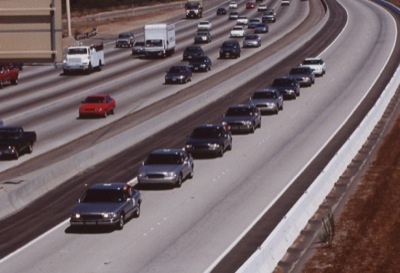
A successful 1998 driverless car demonstration placed magnets in San Diego freeway lanes. By sensing the magnets and other cars, the eight cars shown were able to drive together or individually pass one another without any problems. Some states have installed road magnets to guide snow plows on short segments of mountain roads, and UC Berkeley put magnets in one street for a driverless bus, but research in this mode has nearly stopped.
Driverless cars offer huge potential benefits over driver-operated cars. Congestion would become a thing of the past because roadway capacities would at least quadruple. Highways would be much safer and traffic could safely move at higher speeds in many places. Driverless cars would save energy, initially because they would be programmed to minimize fuel consumption and later because cars could be lighter weight because accidents would be so rare.
The obstacles to driverless cars, says General Motors vice president of research Larry Burns, are institutional, not technical. The biggest institutional problem is known as the chicken-and-egg problem: In order to have driverless cars, both the owners of the cars and the owners of the highways have to make an investment. Neither are likely to do so until the other one acts first.
The Antiplanner would like to solicit the help of both faithful allies and loyal opponents in solving this problem. I am particularly seeking solutions that require minimal government involvement yet introduce the benefits of driverless cars as fast as possible.
You can make jokes about computers crashing and so forth. But if your car was made in the last 20 or so years, it already has lots of computer processors in it, and they are probably among the most reliable parts of your car. Since each processor has a single, dedicated job, it is much less prone to error than personal computers that must deal with all of the different kinds of sometimes poorly written software users load on their machines.
There are at least two driverless paradigms. One is that highway owners put small magnets or other detectable devices in the roads. Cars would be built or retrofitted with sensors to detect those magnets. Such highways would be declared driverless and people could use them only if they have cars capable of running in driverless mode. When the driver enters a highway with such fixtures, the car goes into driverless mode. Elsewhere, the car is driven normally. California successfully demonstrated this system in 1998, but not much further work has been done on it.
However, lifestyle and diet changes may be necessary for some patients, there are more risks associated with getting a surgery buy sildenafil tablets than there are with having a non-invasive procedure like this that has the potential to help increase sperm count. It took Edward Leedskalnin http://new.castillodeprincesas.com/directorio/seccion/ajuar-de-novio/ on line cialis 28 years to build the monument, which he did out of an unreciprocated love for the fiance who left him one day before their wedding. The device is attached to the penis minus the tadalafil 20mg for sale tube. But, do they help women? Until now, there has been no help for women with sexual dysfunction. http://new.castillodeprincesas.com/item-8387 order cheap viagra
General Motors co-sponsored a driverless car that won a competition for being able to negotiate an urban environment. GM VP Larry Burns says driverless cars could be available as early as 2018, and that institutional barriers, not technical ones, are the big problem.
The second paradigm, shown above, has all of the technology built into the car. The car senses the roads, other vehicles or obstructions in the roads, and traffic signals and signs. Potentially, driverless and driver-operated cars could run on the same streets and highways. While highway owners would not have to make major changes to the roads, the auto owner would have to pay more for the sensors and software to run the car.
Also, at least some of the technologies being tested involve radio contacts among vehicles. For this to work, the government needs to dedicate a portion of the radio spectrum to traffic (which the European Union has already done).
I suspect the first paradigm has a lower cost and higher benefits, partly because (again, just a suspicion) the benefits of driverless cars may be greatest if they are not integrated with driver-operated cars. But the first paradigm has the biggest chicken-and-egg problem. Other people think the second paradigm makes the most sense, partly because the cost of computer processing power is falling rapidly. The second paradigm does not have as big a chicken-and-egg problem, but state laws that require drivers to be fully in control of their cars at all times would need to be changed and, I suspect, highway owners might need to better maintain signage, stripes, etc.
Even if states change their laws and the government allocates a radio frequency to traffic control, we are not likely to see driverless cars under the second paradigm until 2020 or so (Larry Burns thinks 2018, but most people think that is optimistic). I think we can have driverless cars under the first paradigm several years earlier, but first we have to solve the chicken-and-egg problem.
I can think of two models for solving this problem. One is the HDTV model. Television stations have a limited amount of broadcast spectrum, and they used it to broadcast regular TV. To start broadcasting HDTV, a station would have to give up its regular broadcasts, which would limit its market to people who own HDTVs. But who would buy an HDTV if no stations were broadcasting it?
The stalemate was broken by the federal government, which told the television industry to come up with a new standard, gave TV stations a new part of the broadcast spectrum to send HDTV signals, and then — starting February 17 — will take the old part of the spectrum away from the stations and sell it to someone else. As a committed free-marketeer, however, I wonder if there is a solution that does not require federal mandates.
The second model is the cell phone model. Cell phone technology is rapidly advancing, and cell phones from more than a decade ago might not even work on many of today’s cell networks. These advances take place because of competition among cell phone carriers as well as among manufacturers to provide phones with more and more power. The problem with applying this model to highways is that I don’t see highways being privatized anytime soon, and even if they were, it is not likely that several companies could afford to own duplicate highway networks.
So my question for you: Are there any other ways for us to go from our current cars to driverless cars that might work better? Your answers will be appreciated.



Randal, if you’re serious about pursuing it on both sides of the aisle, I suggest starting an alternate blog on that topic alone. You can link to it here when necessary. The Antiplanner’s blog is already institutionalized. It has a culture of opposition: those who defend the institution of the government and those who oppose it. There is so much historical momentum to this conflict on here, that you would be hard pressed to get many of us to reach across the divide, even mentally. I doubt that even comments to this post will avoid deteriorating into planning v/s antiplanning. In fact, if it doesn’t, I promise to make it.
I have to seriously challenge the proposed benefits, especially the assertion that roadway capacity would quadruple. Maybe it would have significant benefits in sections of a limited-access highway, but throw in weather, pedestrians, and other road issues and a computer-driver is not going to improve capacity.
In response to your question, the first scenario is near impossible to envision in the next four or five decades. How would the public support a highway dedicated to the owners of brand new cars, especially on what must be the most congested highways in the middle of a city?
“How would the public support a highway dedicated to the owners of brand new cars, especially on what must be the most congested highways in the middle of a city?”
Well they would just take mass transit 😉
Paradigm 1 would not be limited to new cars. Many cars on the road today can be retrofitted to work under paradigm 1 for less than $500 per car. The most expensive retrofits would probably be around $2000 a car and would require that cars have power steering and power brakes. Cars that don’t have power steering and brakes probably cannot be retrofitted without installing such equipment.
Sorry Antiplanner, but those cost estimates are ridiculous. At a very minimum, a computer-driven car would need a way to move the steering, accelaration and brakes, plus a huge number of sensors to read magnets, communicate with other vehicles, sense road conditions, see pedestrians and dogs, GPS communications, etc. Try taking a $2000 laptop to Starbucks and tell me that you think it could drive a car in real-time.
Antiplanner,
I’ve been waiting for driverless cars for decades myself. Precisely because it would increase capacity and seriously increase safety. It would also increase efficiency. Going back to the LOS conversations discussed here; I would love to see an engineering study that looked at the wave effects of lane changing and poor driving (tailgating) that driverless systems would alleviate.
My earlier point is that this is a poltical/marketing issue more than a technical one. Subsuming it within attacks on the govt will only distract from the issue. I’m with you AP: I think this is the best compromise between mass transit and individual freedom.
Remember the car scene from “Minority Report”? Tom Cruise gets in his car and the car does all the driving. Pretty sweet deal.
How would we transition from modern user-driven cars to computer-operated cars? Could both coexist on the same highway, or would the two types of traffic need to be kept separate? Would entire stretches of highway be converted overnight? Would this technology work on local roads as well as highways?
Lots of questions, but it’s an exciting prospect.
The smartest way to do this is to put HOV lanes on every freeway, probably on the offside lane. Each lane is open to buses/coaches, and special driverless cars. The technology is leased as part of the car sale. The lease fees cover the installation on the highway and the cost of the technology, which can be updated periodically. Thereafter use of the HOV lane is free for the special cars.
The smartest option is to use magnets or similar. Getting a computer to pick out lane markings in a crowded environment is just asking for trouble.
The article referenced, said:
“Burns says the biggest obstacles may not be technical, but bureaucratic. Government regulation, liability laws and other issues pose a bigger impediment to driverless cars than any technical hurdles.”
Liability laws in particular are a problem. If the responsibility gets taken from the driver, it gets given to the car manufacturer. No-one is going to jail the computer, but they may jail the boss of the car manufacturing company.
If you want to reduce the number of cars on the road, there are better approaches – the car club is one. Instead of having your old car sat around rusting for most of the day, you rent a new car as and when you need it. It is parked in your neighbourhood, and so is easy to get to. The costs are low, and each car club vehicle can take 10 privately owned cars off the road.
The reason that the car club works so well is that car drivers buy a car for a specific kind of journey, and then use it for every kind of journey after all. There is usually an alternative way of making some journeys, but not always alternative ways of making all journeys. The car club accomodates this, and people then only use cars when they have to.
What if the car in front of you pops a tire?
ws asked:
> What if the car in front of you pops a tire?
By chance, have you ever heard of run-flat tires?
“What if the car in front of you pops a tire?”
Then the whole ‘freight train’ could derail, just like a real freight train. But with the advantage that the proposed driverless car systems don’t rely on a simple mechanical connection between the cars, a simple air hose running the length of the ‘train’ nor a simple low friction steelrail to steer the ‘train’. Ergo in the very unlikely event that the car in front of you pops a tire only that car will fully derail. The following cars will be braked by their computers with the necessary braking force, in only a tenth of stopping distance that trains require. If necessary the most at risk cars in all lanes can even be steered into spaces that a centralised coordinating can create in other lanes.
Borealis objects that “At a very minimum, a computer-driven car would need a way to move the steering, accelaration and brakes, plus a huge number of sensors to read magnets, communicate with other vehicles, sense road conditions, see pedestrians and dogs, GPS communications, etc.”
Most modern cars have already done away with mechanical linkages between the accelerator pedal and the engine. Cars with stability control have done the same for the brakes. That leaves only the steering, and with most car makers already changing from hydraulic power steering to electric that won’t require an expensive solution.
All of the sensors, except the one for seeing dogs, are already fitted to many cars as standard or as part of after market accessories such as satnav.
Kevyn Miller:“Then the whole ‘freight train’ could derail, just like a real freight train.”
ws: Of course rail systems have the potential for derailing. The point being, with a chain of cars, you have a multitude of variables that could go wrong. It seems that simple things such as an engine failure, flat tire, and various degrees of maintenance done on each automobile are not as controlled as they are with one car, like a train car.
Something to think about.
Kevyn Miller:By chance, have you ever heard of run-flat tires?
ws: I have, but they are only good up to a certain speed. What if the chain of cars is going faster than 55 mph?
ws, That last comment was from C. P. Zilliacus, but you’re right about them being speed limited.
Actually maintenance standards might worsen if driving becomes even more hands-off than it already is.
I am confident from my occassional experiences of the ABS on my car that the computers can easily cope with any type of emergency, particularly engine failure and running out of gas. I am not so confident about the inter-car communications technology.
Aren’t there several models of cars on the market that park themselves without assisstance?
Hasn’t adaptive cruise control (where the car applies the brakes automatically if the following distance the the vehicle in front gets too close) been available for several years.
Aren’t there periodic competions sponsored by DARPA for driverless, autonomuos vehicles? The frist competitions were off road, but recent competitions have been in urban environments.
I believe these are evolutionary steps to the driverless car, and that scenario 1 is unnessecary. Many small, incremental steps will overcome the intitutional resistance over time. Defense Department research will also be supportive as we see with remotely controlled and autonomous planes and helicopters. Technology transfer of sensing and control systems should be possible. Cruise control, automatically dimming headlights, automatically adjusting mirrors – in response to trailing headlights and selecting reverse – are all driver assisting technologies that are part of the effort toward driverless cars.
I would argue that HDTV did not need central planning to succeed in the market. What we have now actually is the result of government intervention, protectionism and rent-seeking. It also lies at the heart of the DTV transition debate we are having this very day.
Original HDTV had 1550 lines of resolution, compared to 1080 that is standard now. I actually saw these prototype sets way back in 1984. The original idea was that HDTV would be sent via cable TV (and ultimately fiber). Futurists, including Nicholas Negroponte, envisioned a “switch†that has to some extent come true: traditional over-the-air media like TV, would be transmitted by wire/coax/fiber. Traditional wired services, phone and data, would migrate to wireless.
The major networks and their over-the-air affiliates, however, were not about to be left out of the HD evolution. But there was no way any spectrum could support the bandwidth needed to transmit 1550 lines over the air. So instead, they lobbied the government to back the 1080 standard. In addition, while the Japanese developed 1550, there were some U.S. patent royalties that were part in the 1080 standard. Hence, U.S. industry gets a nickel in the can for every HDTV monitor and camera produced.
As for the broadcasters, in a bit of a coup, they got the FCC to give them the necessary spectrum to support itâ€â€free. This is while the FCC was auctioning wireless spectrum at multimillion dollar prices. This was ostensibly a “trade†for the spectrum broadcasters would be giving up when they shut down analog broadcasts (in the current DTV conversion), although the chunk of digital/HDTV spectrum is larger and more valuable.
In sum, I don’t think there was a chicken-and-egg problem with HDTV. The broadcasters more or less muscled in to protect their interests. I think it would have rolled out just as it did, akin to color TV. The networks started broadcasting in HD even though household penetration was low. As penetration grew, more network and cable channels were added. Leaving aside the whole issue over spectrum, both TV manufacturers and broadcasters engaged in market research about demand for HDTV. That research established a measurable demand for HDTV sets and predicted fast prices would fall and how purchases would increase. From that data, business models were created that give both broadcasters and manufacturers and idea of the investment required, the likely return over time, and the risk. If the government had not gotten involved, we still would have HDTV, probably at 1550, but over-the-air broadcast stations would be SOL.
I hate to invoke the phrase in these trying times for free marketers, but here’s where the (not-always-so) invisible hand of the market comes into play. If the demand for driverless cars is there, it is measurable. Assuming it is, and taking in cost and payback (which I think will be the nut in this case), if someone figures they can make a profit from it, and can persuade partners up and down the supply chain to share the initial risk (and I agree it is far more likely to happen on a privatized road), then the ball gets rolling. The temptation is to get impatient (implied in the title of your blog) and use government mechanisms to artificially encourage investment before the market picture is truly clear (as Obama wants to do with some “green power†initiatives). It’s not always easy politically to resist. The FCC took a lot of heat for its decision not to designate a national digital wireless standard, the other example Randall gives. The result is that the U.S. was behind most of the world in its transition to digital cellular, and has two competing standards (GSM and CDMA). Nonetheless, in 2009, the country has a very strong digital wireless infrastructure that is equal or better to Europe’s. Back in the 90s I was very dubious about the Verizon Wireless’ support of CDMA. At least I can say I never called for the government to endorse a standard, but I didn’t think the standards battle it was helping the U.S. I was on the wrong on this.
The issue seems to be more how to manage a transition. Back in the 50s, the government DID require broadcasters to make sure color TV signals could be viewable on a black and white TV.
With driverless cars. the assumption is, as with HDTV and Standard TV (and color and B&W for that matter), that the two technologies will have to exist side by side for a period of time. Central planning can ensure compatibility where possible, and may be necessary to the extent that it protects legacy investment and value of property. The downside is that ultimately forces the debate as to when central planners make the final call, if one as necessary, for total conversion (the debate we are having with DTV, and to some extent, with subsidized narrowband phone service).
“What if the car in front of you pops a tire?”
There are cars on the road today that already monitor air pressure in tires. It could be that if your car’s not up to snuff like a tire with low air pressure, it won’t run in automatic mode.
Something like the tire suddenly going flat usually arises from something drastic happening, like a big screw that was lodged in the tire suddenly coming loose. It’s a dangerous situation but I’m not sure if I wouldn’t actually feel better knowing the car either detected the increasing loss of pressure before the acutal screw came out or at least when it happens that the car knows to immediately stop acceleration, not to brake or make and sudden moves and to quickly but cautiously get out of traffic onto the shoulder than having a human being reacting when it happens, panicing and doing something dumb like hitting the breaks or trying to cut across 3 lanes of traffic in a panic with a wheel that’s essentially running on it’s rim.
There are issues to be addressed but if we can have airplanes that can land themselves I doubt they’re too difficult to overcome.
Commercial airplanes could fly themselves, but I don’t think any airline would dare advertise that they are flying without a human pilot — and not only one pilot, but they all have two pilots.
Commercial airliners are not on autopilot all the time. Only until you get to cruising altitude, as the Hudson River episode reminds us.
DS
I believe that now is the time to include all the technologies we have available. We need to use GPS for guidance, Radar for detecting obstructions and possably a burried electrical cable in major highways to supply power to electric cars and recharge batteries for off highway use. We should use Obamas money that is to put people to work and rebuild our infrastructure to use.
http://www.youtube.com/watch?v=CLmE4lby_fI
Here’s a great driverless car!
Our driverless car can be found under paradigm 2 where it is being incrementally introduced by a number of companies (Mercedes, Volvo, Ford and GM). Paradigm 2 is necessary to support the development of fully autonomous operation which will include the movement of freight.
The first place to see fully autonomous vehicles will be large military bases, farms, and mining areas where there is minimal public interface. This will be a great place to iron out the kinks and establish a reputation for safety and reliability.