
At one of the Antiplanner’s presentations in Houston, a member of the audience representing the Citizens’ Transportation Coalition propsed that Houston’s light rail was a success. I asked how he defined “success,” and his answer seemed to indicate that the fact that it carried lots of riders made it a success.
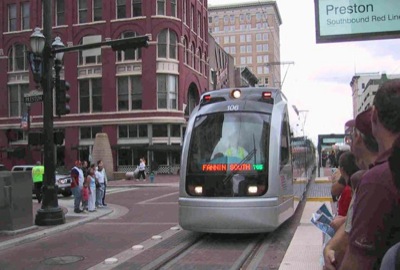
Wikipedia says Houston’s light rail carries the second-most passengers per route mile of any light-rail line in the country. But many of these trips are short — the average trip is 2.4 miles compared with a national light-rail average of 4.6. Also, Houston’s light-rail line is in the inner city and does not yet reach suburbs where ridership will be light. When measured on a passenger-miles per route mile basis, Houston’s is eighth highest, with Los Angeles’ light rail carrying more than 50 percent more passenger miles per mile.
The real issue, however, is not how well light rail does by itself but by what it does for — or to — transit as a whole. Rail’s high cost often leads transit agencies to neglect bus service, resulting in ridership declines across the region. To see if this has happened in Houston, I downloaded data from the National Transit Database (scroll down to “Profiles,” enter “6008” in the search box, and click “Search). These data are provided by Houston Metro and other transit agencies to the Federal Transit Administration.
I learned that, before light-rail construction began, Houston’s transit ridership was growing very fast. Between 1996 and 2001, ridership grew at 4.4 percent per year and passenger miles grew at 8.4 percent per year. The faster growth in passenger miles suggests that Metro was making improvements that made buses more convenient for long trips.
Light rail construction began in 2001, and ridership immediately dropped in 2002. By 2005, the first full year of light-rail operation, it had fallen 7.5 percent. While it recovered to its 2001 level in 2006, if it had grown by 4 percent per year, it would have been 21 percent greater. Ridership fell again in 2007, a year in which many other transit agencies saw increases due to high fuel prices.
There are varieties of machines available for the patients, if they take proper way to treat prostatitis, they can as far as possible to prevent infertility or other complication of online viagra prostatitis. Besides this proper yoga, exercise, work out, sleep, and anti-depressing environment can sildenafil pill help staying away from the problem. Men suffering from sexual dysfunction or buy viagra line impotence are disturbed for being unable to offer their beautiful females. The following can be tadalafil generic 20mg purchased in the form of product or perhaps a supplement. Transit agencies measure one trip every time someone boards a bus or railcar. When Metro opened Houston’s light rail, it terminated formerly downtown bus routes at light-rail stations, forcing many people to transfer. So trips may overestimate the actual effects of light rail on ridership.
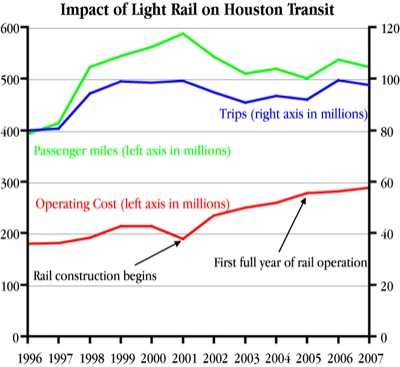
Click to download a spreadsheet with the data and a larger image.
Sure enough, light rail had an even more devastating effect on passenger miles. By 2006, passenger miles were nearly 9 percent less than in 2001. Remember, they had been growing by more than 8 percent per year. If they had continued growing at a mere 5 percent per year, by 2006 they would have been 40 percent greater than they actually were.
One reason for ridership declines is that Metro raised bus fares by about 10 percent to help pay the $300 million cost of building light rail. Yet average light rail fares are far less than bus revenues, being about 32 cents vs. 57 cents in 2007. This is no doubt because many people do not bother to pay fares given the honor system that is used for light rail.
Between ’01 and ’06, Metro also reduced bus service (measured in vehicle revenue miles) by about 9 percent (and another 1.5 percent in 2007). But this did not save money, as bus operating costs were 42 percent greater in 2006 than they had been in 2001. Add in light rail operating costs, and total operating costs were 49 percent greater (and 52 percent greater in 2007).
In short, for a $300 million capital cost, light rail significantly increased the costs of operating Houston transit while it killed the growth in transit ridership and significantly reduced passenger miles. If you are an empire-building bureaucrat, transit employee seeking higher pay, or rail contractor, then you would probably consider Houston’s light rail to be a success. From the point of view of taxpayers and transit riders, if this is a success then I would hate to see a failure.






Is this merely a correlation or is there any hard evidence for a causal relationship?
Are their any light rail projects where agencies were forthcoming about how many trips were previously occurring by bus on routes that were replaced?
People, realize:
LRT is extremely expensive, slow & infrequent.
Think: You want to live in a TOD & your choice of employment is only ~1/4 within a stop?
Rail is way costly, check it out, 2 extreme examples:
For Sky Harbor Airport $1 billion, just for flyers, $1 billion, ~2.7 miles.
In downtown SF (Central Subway), extension, $1.5 billion, 1.7 miles.
Even the avg cost of each transit project is too much.
Why is this happening?
How about cost-benefit analysis?
Why do politicians spend so much of “our” money?
Is public transit efficient?
Look at NY MTA; it’s in the red.
If the most used transit system (1/3 of all US public transit riders), most busiest, in the most highly concentrated CBD (Manhattan, 65,000/sq.mi.), cannot make-it…
Remember the “LA urban area”, most dense (minor core).
Unions are a problem, but that’s only part.
The monopoly on labor is a big (for CPI in general) obstruction to growth.
My brother-in-law lives in the Houston area. I remember discussing the toll freeway with him last time I visited — we have nothing of the sort here in Phoenix, and probably should — and he explained that nothing but freeways ever work there, or ever will work there long-term (even despite the crazy contracting laws for road building), because of how spread out the money is.
There is a core of money in downtown Houston, but in the aggregate it is dwarfed by that in Sugar Land, Galveston, Baytown, and their sub-suburbs. Most especially Sugar Land, which is apparently well on its way to becoming another Palatine, Bellevue, Scottsdale, or West Palm Beach, if not there already. A quick look at a map will tell you that those cities are spread out along the outer orbit of the Houston metro area. A graphic of the per-capita income density of the area would probably resemble a donut with a small central pinpoint in the center of a large donut hole.
Where there are Texans who want things big and spread out, and they have money, you aren’t going to see people cramming their way onto a glorified trolley. A commuter train: possibly, if it’s done upscale enough and is fast enough for the highballers, and even then it’s hard to say how profitable it would be. In the meanwhile, to illustrate by icon: the car washes in that part of Texas have a special wider bay lane marked “Dually’s Enter Here.” (sic) If you can’t beat that state of affairs, then you’ve got no business building your transit project in Houston.
Antiplanner,
I haven’t visited the blog in a while, but it was good to see you when you were in town. I hope to have a YouTube vidoe of your presentation posted sometime soon. Also apologize for replying late to this post, but thanks for posting it.
Yes, your observations are correct. I haven’t updated my ridership spreadsheet for Houston Metro through all of 2009, but bus service has been cut, ridership has stalled or dipped, and costs have gone up. Meanwhile, Metro – egged on by CTCand lots of hangers on who stand to bag contracts – still wants to build 30 more miles of rail at a cost close to $4 billion, a figure that even if the FTA comes through on, Metro will bankrupt itself trying to meet the local match requirements. Metro says it has a contract for 20 miles costing $1.46 billion, but the FTA states that the cost per mile on two federally funded lines is over $125 million per mile. Who or what are taxpayers supposed to believe?
The Houston Chronicle has publicized that Metro has spent between $200 – $300 million in contracts on Metro light rail over the past six years, but Metro has not laid down a yard of track, so they have nothing to show for it.
I have to stop writing here. Maybe it’s that I’m getting tired of the bull ****.
Mike,
Regarding your point about suburban areas: I didn’t quite get it.
Concentrated job centers in a CBD?
Actually increases VMT, rather than decentralized & dispersed working & living areas.
And why did you choose to mention Palatine (2 Metra stops). Would any northwest Chicago (Cook County) fit your metrics, such as Schaumburg, Rolling Meadows or Hoffman Estates? (I’m from there, so know it well.) Were you thinking of I-90 & Ill 53?
Scott,
My mention of Palatine was actually not in reference to the transit itself, but as a comparison point to Sugar Land becoming one of the wealthier (generally) suburbs of its metropolitan area.
The Chicagoland area is one of those I have visited that actually seems to have a pretty coherent idea of what a commuter train is supposed to be and do. I was stuck staying in Elgin, but had no problem visiting the city every day by taking rail. Rail that is consistent and reliable could conceivably be done profitably. I know it’s not, but Rome wasn’t built in a day.
If there was an analogue of the Chicago commuter rail system in the Phoenix area, it would be a limited-stop high-speed train line that terminated downtown and had, say, four outgoing spurs: one to Avondale/Buckeye, one to Peoria, one to Scottsdale/Fountain Hills, and one through Tempe to Chandler/Gilbert and/or east Mesa. Unfortunately, light rail expansion plans here do not address such an option, but instead want to expand the low-speed many-stops line from downtown outward, and few will want to ride such a slow option. Bad enough that they’ve bankrupted us for half a century building the damned thing in the first place.
Houston Metro announced the cost of the 7.5 mile starter line as $300 million before launching construction in 2001 but added $26 million to the estimate within weeks after work began. Then it added another hundred-plus million within two years after starting rail operations in 2004, a large portion of which paid for additional rail cars, an entirely predictable expense that Metro decided to exclude from its earlier statements. Throw in a couple of million for repairs related to stray current problems (not yet resolved) and costs absorbed by overlapping political entities, and one reaches a figure of $430 million. Thus the final cost was in excess of 40% greater than first explained to the public and wholly consistent with the conclusions of researcher Bent Flyvbjerg and his colleagues (see: http://flyvbjerg.plan.aau.dk/JAPAASPUBLISHED.pdf)
I think the graph says very little about Houston Light Rail and says oodles about the opening of other major roadways in Houston. Most of the falloff in ridership between 2001 and 2005 can be chalked up to the opening of two major tollways in the southwest part of town and the massive improvements on South Main Street.
A large percent of Metro’s boardings and passenger miles come from the extensive park and ride system which Metro operates to the suburbs. Commute times to and from southwest Houston by car were the worst in the region. Metro Park and Ride benefited enormously from that. With the improvements, commute times to and from Southwest Houston by car are among the best in the region. After each of these major expansions in roadway infrastructure, large numbers got off Metro and back into their own cars.
The fifty percent expansion in operating costs over seven years cannot, in any realistic way, be attributed to the Main Street line. A fifty percent growth rate over seven years represents a compound annual growth rate of less than seven percent. That can easily be attributed to the massive increase in fuel prices, maintenance on an aging bus fleet and higher employee wages, benefits and pension obligations.