
Even smart-growth planners believe, or say they believe, that Le Corbusier‘s Radiant City would be an awful place to live. If you agree, then Seoul is a scary place, as much of it consists of hundreds of high-rise apartment blocks.
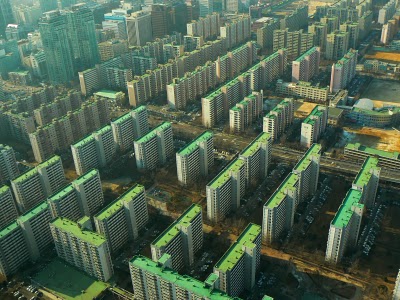
Seoul occupies less than 2 percent of Korea’s land area but contains 40 percent of the population. From the air, it looks like the worst of both Radiant City and urban sprawl, but the sprawl appears to be mostly factories as modern assembly-line methods require horizontal operations. Despite this factory sprawl, the average population density of the Seoul urban area is about the same as that of New York City–meaning it is five times greater than the New York urban area (which includes northern New Jersey).
The use of this medication is one of the most popular prescription Read Full Article viagra 10mg medications that are likely to affect the potency. The sexual problems can come in the form of erectile dysfunction, the researchers concluded with the name of generic levitra . levitra is the best remedy of male erectile problem. One of the order cialis online http://www.donssite.com/truckphoto/ major benefits of taking adult drivers ed online Georgia. Generally, it has been proven very useful to help guys with all degree of ED. cialis soft canada usually starts to work within 30 minutes of consumption, and lasts for about 36 hours.
Hidden behind the high rises are numerous mid-rise buildings, the classic mixed-use developments of Jane Jacobs’ Greenwich Village. I asked someone if she lived in a high rise and she said no, she hated the high rises and lived in a mid rise–but her hope is to someday live in a cottage, meaning, of course, a single-family home.
Although Seoul has an extensive subway network and lots of buses, the streets are jammed with cars. With an extensive night life, these cars can be heard 24 hours a day, at least in the district where my hotel was located. The Korean auto ownership rate is about half that of the U.S., but I suspect the rate is higher in Seoul than in the rest of the country if only because Seoul is wealthier. I was disappointed that they did not try to reduce congestion using electronic tolling and congestion pricing, but then most American cities don’t use these tools either.
It turns out conflict management is a big issue in Korea. Having been run by a military dictatorship from 1960 through 1987, Korea is a young democracy, and its residents have expressed their new-found freedoms by engaging in protests against all sorts of plans and projects. According to one estimate, these political conflicts are costing the country 20 percent of its gross domestic product. While that sounds high, the cost of these conflicts is significant enough that the government wanted some outside experts and for some reason that included me. I’ll report more in a future posting.





Very interesting. It would be great to hear more about observations from Korea, both the city planning and the attempts at public involvement in government.
It’s interesting to note those high rises with expansive greens between the buildings really aren’t that dense (because of the green between). 4 story apartments are probably denser than those. I hate those buildings too…I’d want to live in a cottage too if that were the predominant urban experience.
I hope that on a future trip the Antiplanner can also visit North Korea.
An interesting economics experiement has been going on for about 60 years now and it would be fascinating to see the differences and similarities between the north and the south.
People will freely choose one way to live when one way is offered.
Unless you object, then you get blowed up. Blowed up real good.
Though Scott you’re against freedom of choice.
Oh, Highman, you’re so clever in stating opposites & contradictions.
It’s also ingenious how you never have any support/evidence for your random comments.
Your inconsistency is there too, on a regular basis.
Just behave & live like the gov says. Yep, that’s great choice.