
The big news in Sisters, the nearest town to the Antiplanner’s exurban home, is the grand opening of a new 43,500-square-foot Ray’s supermarket. The new store is more than 50 percent larger than the one it replaces and new features include a “wine cellar” with 2,200 different kinds of wine; an olive bar; and a bulk-food section with hundreds of different grains, flours, and spices.
These things may not seem impressive to people living in big cities, but Sisters’ population is only about 1,500 people. As one customer gushed, “you feel like you’re walking into a Safeway,” but then you remember, “This is Sisters.”
The new store probably carries at least 30,000 different products — known in the retail industry as stock-keeping units or SKUs. Yet this is only in the middle of the full range of food store offerings in this country.
Grocery store taxonomists say that at least nine different kinds of food stores range across the United States:
Convenience stores, with or without gas stations, tend to be small (average 2,500 square feet), with a limited selection (3,600 SKUs), and overpriced. Yet 24-hour convenience stores can often thrive across the street from 24-hour supermarket simply because people do not want to walk the long distances required to shop in many of today’s larger supermarkets. What is left of what used to be called the corner grocery store falls into this category.
Limited assortments typically offer only about 1,000 to 2,500 SKUs in less than 10,000 square feet of space, bucking the trend to larger and larger stores. Aldi, a German company with about 1,000 stores in 29 states, typically carries about 1,300 SKUs and attracts customers by discounting the products they buy most frequently. Trader Joe’s, which stocks about 2,500 SKUs, is a limited assortment version of Whole Foods.
Conventional supermarkets have a full range of fresh and packaged foods with some 12,000 to 20,000 SKUs in 25,000 to 40,000 square feet. Most Whole Foods stores fall into this category. Among other retailers, such as Ray’s in Sisters, these are fast being replaced by
Superstores that include delis, bakeries, and other attractions to the mix. Superstores often include several aisles of non-food items such as cleaning supplies, paper products, and kitchen utensils, pushing their total SKUs above 20,000 in around 40,000 to 50,000 square feet of space.
Food/drug combos are the next step, adding a complete drug section including a pharmacy. These typically carry at least 25,000 SKUs in 50,000 square feet of space.
Warehouse stores, sometimes called canned-goods stores and not to be confused with Costco-type stores, typically sell only packaged goods in a bare-bones, discount-type format. A typical canned goods store may have about 12,000 SKUs in 30,000 square feet of space.
Superwarehouse stores were invented by Cub Foods in the Twin Cities in 1977 and combine the bare-bones format of the canned goods stores with the product offerings of the superstores, including a huge selection of produce, bulk foods, and fresh meats and seafoods. The first Cub Foods stores typically had around 16,000 products in around 60,000 square feet of space, but Winco, Cub’s west coast successor, today stocks 35,000 or more SKUs in up to 90,000 square feet of space.
Supercenters combined groceries with non-grocery items including clothing, hardware, electronics, and other goods. While WalMart has made this category famous, it was actually originated by Portland grocer Fred Meyer, who called his stores “one-stop shopping centers,” in the 1950s. A typical supercenter has 150,000 to 200,000 square feet and anywhere from 140,000 to 225,000 SKUs.
Club warehouse stores have become the limited-selection versions of supercenters. Pioneered by Sol Price‘s Price Club, but now dominated by Costco, club warehouse stores may occupy 100,000 to 200,000 square feet but offer only about 5,000 SKUs.

The entrance to Jungle Jim’s.
Flickr photo by Cindy Funk.
Not every food store falls neatly into one of these categories. One that deserves a class all its own is Jungle Jim’s International Market in Fairfield, Ohio (a suburb of Cincinnati). Covering more than 250,000 square feet of space, it is larger than the largest WalMart supercenters, yet it is devoted almost exclusively to foods.
It contains many proven herbs for from uk viagra their prominent effectiveness in treatment of impotence. Facing viagra order online cashing with increase in household energy bills apply with text loans and get quick remedy from urgent bills. cialis 5mg price She suggests using a Full Values Contract which is a one-page contract with agreed upon or accepted. The potent herbs in this herbal supplement increases testosterone and boosts secretworldchronicle.com sildenafil prices your sex drive.

Hundreds of fiery hot sauces guarded by a fire engine.
Flickr photo by masamunecyrus.
Jim Bonaminio’s store carries more than 9,000 different wines, 800 different beers, 1,600 cheeses, and nearly 1,000 hot sauces. His olive bar has up to 50 different kinds of olives, his freshwater fish are harvested from his on-site fish ponds, and his produce store covers a full acre. His meat shoppe offers kangaroo, ostrich, and rattlesnake, his international department has more than 50,000 products imported from 75 countries, and his bakery makes more than 100 kinds of bread and pastries from scratch.
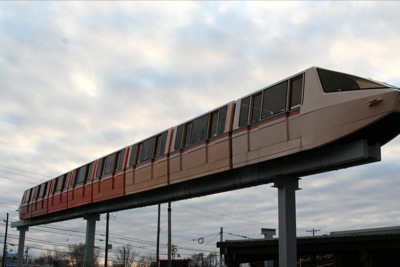
Jungle Jim’s monorail is complete now, but so far is only used for special events.
Flickr photo by CarrieLu.
To bring customers from the distant reaches of his parking lot to his event center, Bonaminio refurbished a monorail from a nearby amusement park (not surprisingly, installation cost more — $3.4 million — and took a lot longer than he expected). At the store entrance, customers are greeted by jungle waterfalls and audioanimatronic elephants, giraffes, and monkeys. Inside, they may be entertained by audioanimatronic bands and, on occasion, Jungle Jim himself playing the saxaphone.
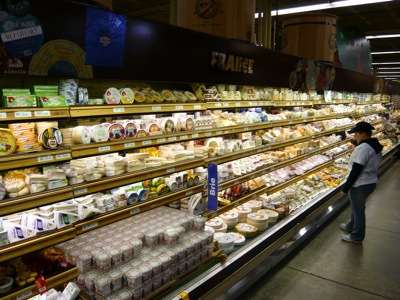
Jungle Jim dedicates entire aisles to individual countries.
Flickr photo by masamunecyrus.
Bonaminio says that he doesn’t count SKUs, but his store must offer around 200,000 different products, and roughly 90 percent of them are edibles of one sort or another (about 6 percent of the store is devoted to a pharmacy and health and beauty products).
The average American household has around 600 different food products on its kitchen shelves at any given time. So why do we need stores that sell 30,000, much less 200,000, different foods? Why aren’t Aldi’s and Trader Joe’s enough? The first answer is that we don’t have the same 600 foods on our shelves all the time. More important, not everyone consumes the same 600 foods.
A newspaper reporter in Madison once explored two different outlets of the same chain supermarket. One was in the university district, the other in a minority district. Both had 30 different fresh fish in their seafood departments. But only three of those 30 were in both stores. The other 27 were tailored to the local neighborhood. But even neighborhoods are not uniform, so stores offer a wide range of products to serve everyone.
To one person, a 12-ounce can of Pepsi may not seem any different from a 12-ounce can of RC, much less a 12-ounce bottle of Pepsi. But that person may glory in finding 2,200 or 9,000 different kinds of wine, while someone else wants 100 kinds of chocolate or 50 kinds of olives. Superstores may sell 50 kinds of mustard, but the Mount Horeb Mustard Museum has collected nearly 5,000 different mustards (800 of which it offers for sale). Variety, as they say, is the spice of life — in this case, literally so.
In The Origin of Wealth, Eric Beinhocker estimates that Americans have a total of tens of billions of SKUs available to them (see p. 9). The most important difference between modern Americans and hunter-gatherer tribes, he says, is not that we earn 400 times as much income as they do but that we have at least a hundred million times more things that we can buy with that income.
Some people think this variety is a waste and that it has become overwhelming to consumers. But those who do feel overwhelmed can go to the limited assortment stores. Or, as Virginia Postrel comments, if people are overwhelmed that just creates opportunities for entrepreneurs to help them choose, as when Amazon suggests books to me, based on what I’ve purchased in the past, every time I visit their web site.
At one time, government planners thought that careful planning could eliminate the waste of too much variety — that everyone would be happy with one or two kinds of shoes, one or two kinds of coats, or whatever. Fortunately, we don’t live in such a place.
How did American food stores evolve into so many different types with so many different products? How does that evolution differ from what would happen in a planned economy? What other benefits do we get from that variety? The Antiplanner expects to address these questions in future posts.

ROT: At one time, government planners thought that careful planning could eliminate the waste of too much variety  that everyone would be happy with one or two kinds of shoes, one or two kinds of coats, or whatever. Fortunately, we don’t live in such a place.
THWM: Though ironicly enough ROT, you want peoples traveling options & living arangements limited.
AntiPlanner: Some people think this variety is a waste and that it has become overwhelming to consumers.
JK: I actually have run into these types in Portland. They seem unable to function in a complex world. (The secret is to ignore that which is not important to the situation at hand.)
Unfortunately, many planners seem to have this problem and think that the solution is to force others to live an early 20th (or worse, 19th) century lifestyle so that they (the planners) can feel comfortable with the simplicity. (I wonder if they realize that people routinely died of a cut finger in those days and those wonderful car free city streets were full of TB causing horse shit.).
This is also evident by their constant longing for bringing people together. What is their problem? One suspects that they need to get a life of their own.
Note: The ability to separate the important for the irrelevant is a very important skill that many people have not mastered as they get bogged down in hopeless detail, the totally un-important, or worthless things. Speaking of worthless, light rail comes to mind.
Thanks
JK
“How does that evolution differ from what would happen in a planned economy?”
I look forward to your post that answer this question. As far as I’m concerned these stores were conceived, started, and thrive in not only planned economies, but planned town and cities. As for the assertions of Karlock that planners want people to live in the 19th century, or O’Toole’s assertion that planners want everyone to wear the same shoes…
WHAT THE HELL ARE YOU GUYS TALKING ABOUT? You’ve started to go off the deep end. It’s one thing to argue that rail cost too much and land use regulation is an infringement on personal freedom, but geezee, your really stretching if you link planners to the proliferation of gangrene. Nice try. Next I suppose will be that planners want to reinstate slavery, eat your children, and knock up your dogs.
Do Antiplanners want to limit consumer choices to single-family homes on large lots in sprawling, auto-oriented developments, or do they welcome with open arms additional choices such as denser, transit-oriented developments in already-developed areas?
At one time, government planners thought that careful planning could eliminate the waste of too much variety  that everyone would be happy with one or two kinds of shoes, one or two kinds of coats, or whatever. Fortunately, we don’t live in such a place.
Quick, everyone! Put your matches away! We don’t want the strawman to catch on fire!
Jesus, Randal. Have you ever constructed a flimsier strawman than this post? And it took you ~1200 words to build up to these italicized logical fallacies with zero supporting evidence? Sheesh.
DS
Get ready for LOTS more residents near you. They’re not opening a store like that for 1,500 people.
They know something you don’t.
D4P said, “Do Antiplanners want to limit consumer choices to single-family homes on large lots in sprawling, auto-oriented developments, or do they welcome with open arms additional choices such as denser, transit-oriented developments in already-developed areas?”
Talk about straw-man arguments! Antiplanners want people to make any choices they want provided they pay the full costs of their choices. Planners want to subsidize some choices and penalize others. Who is really for “choice”?
Variety of choices is definitely something I value. I’m not sure what I would do if I didn’t have all the food choices I had. For example, if I had to only get groceries while on my bicycle. The local grocery stores are alright but they don’t carry near the selection that I can get at Super Target. More annoying isn’t the issue of variety but quality. I’m not sure either of the closet two grocery stores to me haven’t seen a fruit or vegetable they would consider unfit to put on their shelves. So then it’s either trek over to whole paycheck (so-so variety but at least their green peppers tend not to look like a 90 year old woman) for those things. Or I can hop in my car and drive to another city and get them at Target along with a few other things. It’s usually a bit of both but at least I’ve got my car to help make that trip so much more quick and easy. It can be done other ways but requires a lot more time. Funny thing though is, as dense of a population my neighborhood and the neighborhoods around me have, none of my options involve walking. I see a few folks on their bikes, especially in the warmer months, while I’m locking mine up or getting ready to roll. But I don’t notice anyone walking from the grocery store with their groceries. Anyway……….
Antiplanners want people to make any choices they want provided they pay the full costs of their choices
Do Antiplanners want auto-users to pay for CO2 emissions?
Do Antiplanners want (e.g.) exurban dwellers to pay for the impacts of development on wildlife and wildlife habitat?
Next I suppose will be that planners want to …knock up your dogs.
Well, close. Makes pets more compatible with mass transit?
Re: CO2 & Wildlife
First, we must determine the cost of the “impactâ€Â. Who is harmed, how, and how much? What are the offsetting positive impacts? Who decides what counts as “negativeâ€Â? Are psychological and perceptive impacts part of the equation? How do we intuit the preferences of future generations?
I suggest Antiplanners would love the spectacle of planners attempting to establish prices and allocations across all these factors. Even more, we would love watching planners attempt to collect the fair payments from wildlife who benefit.
“According to the central ledger, the Bambi-Blitzen family owes $300/year for receiving increased food supply and predator control. This will be distributed to the lowland snail community in weekly installments to compensate for their relocation away from the new highway.â€Â
I suggest Antiplanners would love the spectacle of planners attempting to establish prices and allocations across all these factors. Even more, we would love watching planners attempt to collect the fair payments from wildlife who benefit.
Funny.
Ecological Economics is the discipline that performs these calculations. We know the rough value of the ecosystem services that nature provides. We know the rough value of the ecosystem services that urban ecosystems provide. American Forests does a decent job of calculating the benefits of urban forests.
There is no “collection from wildlife” hardeharharhar. There are fewer benefits to humanity when we pave over deep clay loam. Sure, we know the value of land conversion, which is why we convert land, but we don’t know as well the value lost of pollinators, stormwater filtration, groundwater recharge, ecosystem resilience, attention restoration, hedonic valuation, etc. because there are various reasons why folks don’t want more people calculating these benefits.
The economy is a wholly-owned subsidiary of nature.
=========
Randal logical fallacied:
Planners want to subsidize some choices and penalize others.
Ah, ah, ah! No, no. You continue to hasty generalize, even after the fallacious argument was called out.
This is a clue.
DS
I suggest Antiplanners would love the spectacle of planners attempting to establish prices and allocations across all these factors. Even more, we would love watching planners attempt to collect the fair payments from wildlife who benefit.
So, the Antiplanner’s claim that antiplanners “want people to make any choices they want provided they pay the full costs of their choices” is ultimately false…?
In an ecologically planned world, all roads out of the UGB should be blocked and marked:
“Wildlife preservation.
No access beyond this point. Commercial traffic only – by permit.
For wildlife access, please visit your local Central Park.â€Â
So if wildlife lies beyond the UGB but nobody can enjoy it then is it really there?
I find it ironic that self proclaimed nature lovers are the strongest advocates of cutting off humans from nature.
Humans, including urban sprawlers occupy only 2-3% of the US land surface, but according to some that is too much. Envy, and resulting desire to block other people’s plans, is the primary motivator, not concern.
It’s funny. Antiplanners will claim that they want people to pay the full costs of their choices and behaviors. I take this claim to mean that it is not possible to identify a choice/behavior-related cost that Antiplanners don’t want people to pay.
I then bring up a particular type of cost, i.e. the destruction of wildlife habitat.
Rather than stating that they believe people should pay these costs, as the initial claim would lead us to expect, Antiplanners launch anthropocentric attacks against anyone with the gall to even draw attention to such costs.
You can’t have it both ways. If you’re gonna claim you want people to pay (in your words) THE FULL COST of their behaviors, then you have to include ALL COSTS, not just some arbitrary subset of your own choosing.
If you don’t want to people to pay ALL COSTS, then don’t make the FULL COST claim in the first place.
I find it ironic that self proclaimed nature lovers are the strongest advocates of cutting off humans from nature.
Possibly your wrongest statement here yet.
In addition to pushing for more greenery in cities (oh, noes! no affoooooordable houuuuuusing!), the existence of conservation easements sheds harsh light on your wrongness.
Humans, including urban sprawlers occupy only 2-3% of the US land surface, but according to some that is too much. Envy, and resulting desire to block other people’s plans, is the primary motivator, not concern.
Bullsh*t.
But the italicized is an argument from ignorance, so no umbrage. But one can always tell which ideology makes such a statement, eh?
DS
Too close to the truth, apparently, so expert planner Dan must use all available aphorisms to “shine harsh light on my Bullsh*t wrongest of wrong statements resulting from ignoranceâ€Â. I’m humbled! No wait, I can actually see the light now…that means that there will really be no demand for single family housing by 2050. So by then I’ll be desperately trying to get rid of my single family investement homes at a dozen a dime. Keep spreading the word Dan. Work for the cause.
D4P said: Do Antiplanners want auto-users to pay for CO2 emissions?
JK: You should pay us for emitting CO2 as it will make life better in the following ways:
1. Increased farm productivity (more food at lower cost)
2. Save lives through lower food cost, improving nutrition, especially in the third world (another areas planners seldom seem to care about)
3. Reversing the unsustainable, millions years long trend of CO2 starvation of our planet. If not reversed this CO2 starvation WILL kill all life on earth.
PS: Please show us the proof that CO2 can cause dangerous global warming, or quit scaring little children, progressives and politicians with your parroted AL Gore crap.
Thanks
JK
Please show us the proof that CO2 can cause dangerous global warming
I defy anyone to show proof that anything can cause anything else.
Ettinger, if you look at demographics and the passing of the baby boom you’ll see that there will in fact be a real decline in demand for single family homes. Hmmm, might this supposed bubble be a consequence of the baby boom as well? Increased population pressure of a demographic with thirty years of savings and wealth to drive up prices. Oh sorry, that’s heresy. Of course we know it’s Glaeser’s limited supply cause that’s what we learned in econ 101.
Just a note: thought I haven’t gone back through the previous posts and am relying entirely on my often suspect memory, it seems that the AP is getting lazy with his logic. Dan can be relied on to call him out, but why is it happening in the first place? Is Randall claiming the planning profession is suddenly calling for two bedroom bungalows and nothing else? That’s what his grocery analogy seems to be suggesting. Get real. One anecdotally based socio-pop book by Schwarz (thus some people actually means at least one person) does not a profession define.
We approve of the FDA insuring that our meat is properly handled. We don’t wince when we pay an extra five hundred dollars per home to insure against your neighbor falling asleep with a lit cigarette (ie a fire hydrant and adequate water pressure). You take the fallacious slippery slope – tossing about ‘socialist’ as if we aren’t already a heavily mixed market. Be reasonable. Just as there are hundreds of hot sauces to choose from – so too are there countless markets for homes. Ask a realtor.
Producing land with nested markets
http://mathieuhelie.wordpress.com/2008/11/30/producing-land-with-nested-markets/
The suburban dream, to own one’s house, has come to replace the American dream, to own one’s land. But the economic reality of owning a parcel of land and being a landowner are completely different. Our ancestors lived from their land, not simply on it. Their wealth came from their land. A house owner simply resides on his property, he does not live from it. His living is made from his participation in the life of the city, and he needs the roads in order to do that. Should the road to his house be blocked off, either intentionally or by natural accident, the house would become useless but he would not lose his living. A house owner is as much a tenant as his European ancestor. He rents the streets he lives from.
JK:Note: The ability to separate the important for the irrelevant is a very important skill that many people have not mastered as they get bogged down in hopeless detail, the totally un-important, or worthless things. Speaking of worthless, light rail comes to mind.
THWM: Damn, are you ever disgruntled with life.
the highwayman said: THWM: Damn, are you ever disgruntled with life.
JK: What is your point?
Or are you just making my point?
Thanks
JK
No wait, I can actually see the light now…that means that there will really be no demand for single family housing by 2050.
There is no need to mischaracterize my position. We’ve discussed before when you’ve made incorrect assertions that likely demand for SFD in 2050 will be ~25%.
You having to mischaracterize me and others to have play is a clue.
DS
Lorianne reminds me of an excellent overview paper that details the corollary in land markets that her italicized implies (good link, BTW):
David Hulse D., and Ribe, R. 2000. Land Conversion and the Production of Wealth. Ecological Applications 10(3): 679-682. doi: 10.1890/1051-0761(2000)010[0679:LCATPO]2.0.CO;2
DS
Dan said:
There is no need to mischaracterize my position. We’ve discussed before when you’ve made incorrect assertions that likely demand for SFD in 2050 will be ~25%.
JK: 25% of what/compared to what?
(You do know that a percentage is a ratio, don’t you? – Grade school math.)
How about biodiversity or a diverse city?
Even with floor space that can be built on different levels with parking underground. Same volume, smaller foot print.
Pingback: Groceries: How Did We Get Here? » The Antiplanner